
AI Agents vs. Traditional Automation: Which One Actually Delivers Better ROI?
17 Aug 2026
So, if you are considering whether to go for AI agents or automation for your business operations, here is the answer: traditional automation is better for routine, rule-based, large-scale operations, and AI agents add more value to judgment-based, unstructured, or exception-based work. So, the real choice is not about picking a “better” technology, but about fitting the workflow.
The mismatch can make even the most sophisticated AI agent more expensive than traditional automation, but if you get the fit right, either option or their combination can help to reduce expenses, make decision-making faster, and release your employees to do more valuable things. This guide will explain what the difference between AI and automation really is, what situations each solution works best in, what it costs to use each, and how to choose.
AI Agents vs. Traditional Automation: What's the Real Difference?
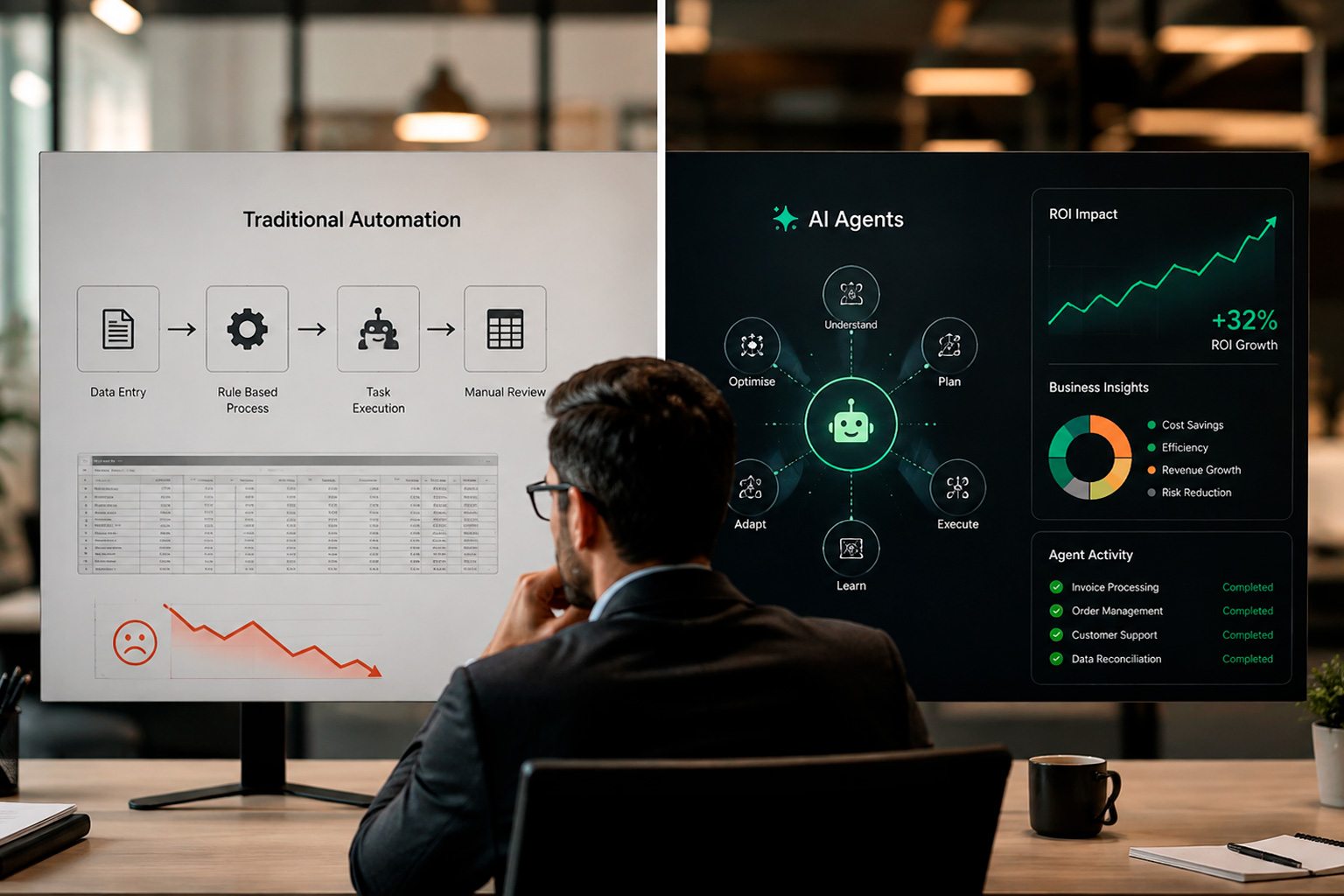
Traditional automation, RPA, workflow engines, scripts, and business rule-based systems are rigid and strictly follow a set of instructions. They perform the same actions every time, handle structured data well, and fail at the first unexpected change in the process.
On the other hand, AI agents are based on large language models and have access to tools and business data. An AI agent can understand the context, solve multi-step problems, choose actions to be performed, and adjust itself to the boundaries defined by you. An AI agent is not limited to a script and can read an unstructured support email, gather data from multiple systems, and make decisions about what to do next.
There is no sense in arguing which approach is more intelligent and more useful. Both methods can be applied depending on your processes and specific tasks.
AI Agent vs. Traditional Automation Architecture
The biggest architectural difference is where decision-making happens.
In traditional automation, the workflow is usually deterministic: an input triggers predefined rules, the automation executes a known sequence of actions, and the system produces an expected output.
A typical architecture looks like:
Input → Business Rules → Workflow/RPA/API → System Action → Output
AI agent architectures introduce a reasoning and decision layer. The agent can interpret an input, retrieve relevant context, select tools, determine the next step, and escalate when the task falls outside its defined boundaries.
A simplified architecture looks like:
Input → AI Agent → Context/Data → Tool or API Selection → Action → Validation → Output
A hybrid architecture combines both approaches:
Input → AI Agent → Decision → Traditional Automation/API → Validation → Human Escalation When Required
This distinction matters because businesses do not need to replace deterministic automation simply because AI agents are available. In many enterprise workflows, the most effective architecture uses AI for interpretation and decision-making while keeping execution inside reliable APIs, workflow engines, or existing automation systems.
AI Agents vs. Traditional Automation: Side-by-Side Comparison
| Dimension |
Traditional Automation |
AI Agents |
Hybrid Approach |
| Decision-making |
Predefined rules |
Contextual reasoning |
Agent decides, automation executes |
| Best input type |
Structured data |
Structured + unstructured |
Both |
| Handles exceptions |
Limited, needs new rules |
Dynamic, adaptive |
Dynamic with fallbacks |
| Predictability |
Very high |
Variable, needs guardrails |
High, with defined boundaries |
| Cost profile |
Low per transaction at scale |
Higher per task, scales with usage |
Balanced by task type |
| Best fit |
Stable, repetitive workflows |
Judgment-heavy, variable work |
Complex, mixed workflows |
When Traditional Automation Still Wins
Traditional automation remains the more cost-effective choice for:
- High-volume, repeatable transactions, invoice processing, data entry, record updates
- Stable rules that rarely change, compliance checks, scheduled reports
- Structured data moving between systems, API integrations, database syncs
- Fixed approval workflows, onboarding checklists, standard sign-offs
If deterministic automation already solves the problem reliably and cheaply, layering on AI doesn't automatically create better ROI; it just adds complexity and cost.
Where AI Agents Deliver More Value
AI agents earn their cost when the work involves:
- Unstructured inputs, emails, PDFs, chat transcripts, support tickets
- Frequent exceptions that don't fit a fixed rule set
- Multi-step workflows that require pulling context from multiple systems before acting
- Customer-facing interactions where tone and context matter
- Decision support, summarizing, prioritizing, or recommending the next action for a human to approve
In practice, agent value increases wherever human judgment has become the bottleneck slowing your team down.
What We See in Business Automation Projects
Among the most widespread pitfalls in automation cases is selecting a technology without analyzing the workflow. The process may seem like a suitable application for AI as it comprises many calculations or labor-intensive processes, but this does not mean that an AI agent is the optimal option.
From our experience, we notice that the most appropriate cases for automation arise when companies first map the workflow, measure exception rates, and see that human decisions impede the process flow. Tasks that are quite predictable are more suitable for deterministic automation than for using AI agents. In contrast, unstructured workflows are more appropriate for AI agents.
Such differentiation will also help businesses not to use AI in their processes that already have reliable and efficient execution via APIs and workflow engines.
The Real ROI Question: It's Not Just About Hours Saved
Traditional ROI models measure automation in labor hours saved, error reduction, and processing volume. That still matters, but it's an incomplete picture for AI agents. Agent ROI also comes from faster decisions, fewer escalations, quicker exception resolution, and freeing skilled employees from repetitive judgment calls to focus on higher-value work.
Analyst forecasts from firms like Gartner point to AI agents becoming embedded in a growing share of enterprise applications over the next few years, and multiple industry surveys show most organizations are increasing AI agent investment. But those returns only materialize when a business measures a real baseline before deployment, not after. Before comparing costs, track how long your current process takes, how often it breaks, and how much manual intervention it needs. Without that baseline, any ROI figure, for automation or AI, is just a guess.
How to Calculate Automation ROI
A practical ROI comparison should account for more than software licensing or AI model costs. Businesses should compare the total cost of the current process against the total cost of operating the proposed solution.
For traditional automation, the calculation can include:
Labor savings + error reduction + productivity gains − implementation and maintenance costs
For AI agents, the calculation should also account for:
Labor savings + faster decisions + reduced escalations + productivity gains − model usage + infrastructure + integration + monitoring + human review costs
This is why comparing an AI agent's API cost directly with an automation tool's subscription price can produce a misleading result. The relevant question is the total cost of completing the business process, not simply the cost of the technology.
A useful baseline should include processing time, transaction volume, error rate, exception frequency, manual intervention, and the cost of delays. These measurements provide a consistent basis for deciding whether traditional automation, AI agents, or a hybrid architecture delivers the stronger return.
Hybrid Automation: The Practical Middle Ground
For most businesses, the strongest architecture isn't “AI agents instead of automation”; it's AI agents and automation working together. In a hybrid model:
- The agent layer reads context, makes decisions, and handles exceptions
- The automation layer executes the deterministic steps through APIs, RPA, or workflow engines
- A human approves high-risk or ambiguous actions
- A governance layer manages access, permissions, and monitoring
A simple example: an AI agent reads an incoming customer email, checks the CRM for account history, decides which workflow applies, and hands the routine part of the task to existing automation to execute. The agent adds judgment; the automation adds reliability.
How to Decide What Your Business Needs
- Map the workflow from start to finish.
- Check whether the inputs are structured or unstructured.
- Measure how often exceptions occur.
- Identify where human judgment is genuinely required.
- Calculate your current cost and decision delay.
- Pilot the lower-risk option first, then measure before scaling.
Common Mistakes to Avoid
- Replacing working automation with AI agents just because AI is newer
- Deploying an agent without a measurable business problem to solve
- Giving an agent broader system access than the task requires
- Skipping baseline measurement before rollout
- Automating a broken process instead of redesigning it first
Frequently Asked Questions
Q: What is the difference between AI agents and traditional automation?
Traditional automation follows fixed, pre-programmed rules and works best on structured, repetitive tasks. AI agents use reasoning and context to handle variable, judgment-heavy work and can adapt without being reprogrammed for every new scenario.
Q: Are AI agents better than RPA?
Not universally. RPA is typically cheaper and more reliable for stable, high-volume, rule-based tasks. AI agents perform better on unstructured or exception-heavy work where fixed rules can't cover every case.
Q: Can AI agents and RPA work together?
Yes. Many businesses use a hybrid model where an AI agent makes the decision and existing RPA or workflow automation executes the resulting action.
Q: Are AI agents more expensive than traditional automation?
It depends on the task. Simple, high-volume transactions are usually cheaper with RPA. Judgment-heavy, exception-prone work is often more cost-effective with an AI agent once you factor in the manual labor it replaces.
Q: How do I calculate ROI from AI agents?
Start with a measurable baseline of your current process, time, error rate, and manual intervention, then compare it against the agent's performance on those same metrics, including decision speed and reduced escalations.
Q: What is hybrid automation?
An architecture where AI agents handle reasoning, judgment, and exceptions while traditional automation executes deterministic steps, with human approval and governance built in for higher-risk actions.
Build the Right Automation Strategy with NanoByte Technologies
Choosing between AI agents, traditional automation, or a hybrid model isn't a decision you should make in the abstract; it depends on your workflows, your data, and where your team is actually losing time.
NanoByte Technologies works with businesses worldwide to map existing processes, identify where automation or AI agents create the strongest ROI, and build the integration, governance, and monitoring needed to run it safely at scale, across AI/ML, custom software development, DevOps, and cloud infrastructure.
.jfif)


.jpeg)