
AI Code Generation in Enterprise Pipelines: Governance, Security, and Code Quality
08 Oct 2026
Quick Summary: How Do You Secure AI Code Generation in Enterprise Pipelines?
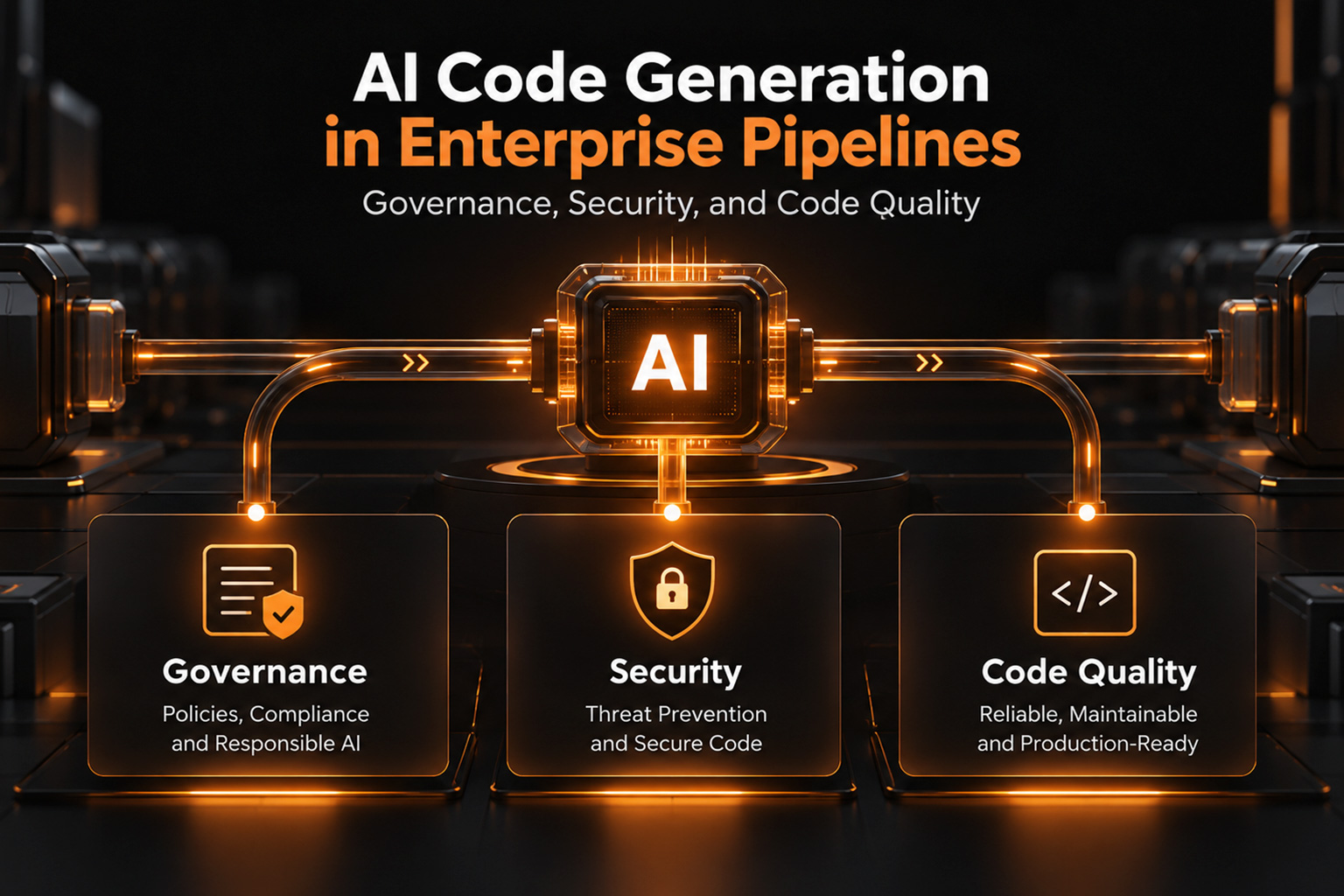
Enterprise AI code generation governance works when it covers the whole software lifecycle, not just the editor. Start with approved AI tools and providers, then define which source code and data may leave your environment and configure those tools securely. Send every AI-assisted change through the same gates as any other: code review, SAST, software composition analysis (SCA) and dependency controls, secrets scanning, license and IP review, automated tests, and CI/CD policy checks. Assign a named engineer to every merged change. No single control is enough, because each one covers a different failure mode, and accountability stays with people, not the assistant.
1. The AI Velocity Trap: High Speed, Low Maintainability
Developers are already using AI coding assistants, sanctioned or not. The enterprise question is what happens to the code afterward.
Code generation velocity measures how fast code appears. Software engineering quality measures whether that code is correct, secure, maintainable, and consistent with your architecture. An assistant can raise the first without improving the second. It can produce a function that compiles and passes a happy-path test while duplicating an existing service, bypassing an internal abstraction, or mishandling a business rule. Reviewers and the codebase absorb that cost later.
The biggest enterprise AI coding risk is not that developers use AI. It is that AI-generated changes enter the pipeline without changing the controls around them.
IP and Licensing Risk
AI-generated code raises provenance questions: whether a suggestion resembles existing public code, which license would apply, and whether proprietary code was exposed to the tool. These are policy and review problems, not proof that assistants routinely reproduce copyleft code. GitHub, for example, lets administrators block suggestions that match public code. It ties IP indemnification for Copilot Business and Enterprise to that filter being set to block. Even so, you still need your own scanning and legal review.
Dependency and Supply-Chain Risk
Assistants also suggest packages, APIs, and versions that no one has vetted. A USENIX Security 2025 study of 16 code-generating models found package hallucination, meaning recommendations of packages that do not exist, to be a persistent and systemic phenomenon. Attackers can register a fabricated name on a public registry, which turns a model error into a supply-chain opening. Many suggestions are not malicious, only outdated, vulnerable, or unapproved. Treat AI-generated dependency suggestions as untrusted recommendations until validated.
2. Ungoverned AI Coding Tools vs. Enterprise AI Governance
Most organizations sit somewhere between these two states. The comparison below shows what changes when governance replaces individual discretion.
|
Governance Vector |
Ungoverned AI Coding |
A Practical Enterprise Governance Model |
|
Data handling |
Uncontrolled developer configuration |
Approved enterprise policies and provider controls |
|
Source-code exposure |
Difficult to monitor |
Controlled through approved tools and policies |
|
Dependencies |
Developer judgment |
SCA, allowlists, private registries, validation |
|
IP/licensing |
Manual/unclear |
Policy plus scanning and review |
|
Security review |
Variable |
Automated CI/CD gates |
|
Code quality |
Individual developer judgment |
Automated quality controls plus human review |
|
Accountability |
Ambiguous |
Defined ownership and approval |
The right-hand column does not remove developer judgment. It moves routine decisions into enforced defaults so that judgment goes where it matters, such as design trade-offs and security-sensitive logic.
3. The Four Technical Pillars of Enterprise AI Code Generation Governance
Pillar 1: Data Privacy and Model Boundaries
Start with what leaves your environment. Which code, context, and files reach the tool? Where are they processed, retained, or used for training? Who can read the logs? Vendors answer these differently, and plan tier changes the answer.
- GitHub: Copilot prompts and suggestions are not retained for IDE use under Business and Enterprise, but other access paths retain them for 28 days.
- Cursor: Privacy Mode is enforceable organization-wide, and some models fall outside its zero-retention agreements.
- Amazon Bedrock: AWS documents that it does not store or log prompts and completions and does not use them to train AWS models.
- Azure OpenAI: Microsoft says prompts and outputs are not used to train base models. It also says it stores prompts and generated content for up to 30 days for abuse monitoring unless an exception is approved.
Private networking, zero data retention (ZDR), and no-training commitments solve different problems. Networking controls the path, retention terms control storage, and training terms control reuse. A private endpoint can still lead to a service that retains data for 30 days. ZDR does not settle licensing or output-IP questions. None of the three controls which repositories developers send.
That is why content exclusions, identity controls, and logging still matter. An enterprise AI gateway can centralize routing, redaction, and audit logs across providers, while self-hosted models shift patching, access control, and evaluation to your team. Many organizations bring in enterprise generative AI coding policy consultants at this stage to turn vendor documentation into enforceable policy.
Pillar 2: Supply-Chain and Dependency Security
Every dependency an assistant proposes should meet the same controls as one a developer chose by hand. Serve installs from a private registry or proxy limited to approved sources, and use package allowlists where the risk justifies them. Pin versions and commit lockfiles so builds are reproducible and a newly published package cannot slip in unnoticed.
SCA evaluates third-party components against known vulnerabilities and license terms. Malicious-package detection adds reputation and behavior checks, which matter because a freshly registered malicious package has no CVE to match. Generate a software bill of materials (SBOM) for released artifacts so incident responders can trace exposure quickly.
Pillar 3: Shift-Left Security and License Compliance
AI-generated code should be treated as untrusted input, not because it is inherently worse than human code, but because generation is not validation. It should meet the same security standard as any other code, enforced in layers:
- IDE checks catch issues as code is written.
- Pre-commit hooks stop secrets and obvious flaws from entering history.
- Pull-request scanning runs SAST, SCA, and secrets detection.
- Automated tests verify behavior.
SAST identifies insecure patterns in generated code. It does not find business-logic flaws or judge design quality, which is why it is one layer and not a verdict.
License review answers a separate question. Similarity and license-scanning tools can flag matches against known code, but none detects everything. Use their output as a risk signal that feeds a human decision. Applied consistently before and after the model call, these layers form a secure LLM code generation pipeline.
Pillar 4: Architectural Review, Testing, and Maintainability
Code can work and still be poor engineering. Assistants optimize for a locally plausible answer, so they often produce duplicated logic, unnecessary abstractions, dead code, inconsistent patterns, thin error handling, extra dependencies, and performance blind spots. Over time that becomes architectural drift.
Counter it with architecture decision records, linters that encode standards, coverage and complexity thresholds, performance tests on hot paths, and reviewers who ask whether a change should exist, not only whether it runs. AI-assisted pull-request review can summarize diffs and surface defects at scale, but LLM reviewers miss issues and can be confidently wrong. An AI reviewer should support human engineering ownership, never replace it.
4. How Should Enterprises Govern GitHub Copilot and Cursor in CI/CD?
Short answer: separate tool-specific controls from organization-wide governance. Editor settings protect the point of generation. The pipeline protects production.
The lifecycle looks like this:
Developer → AI Assistant → Local Validation → Pull Request → Security Scanning → Code Review → CI/CD → Production Monitoring
Tool-specific options are not identical. Copilot offers organization policies such as public-code matching and content exclusion. Cursor offers enforceable Privacy Mode and administrative controls over models and agents. If developers use personal API keys with Cursor, zero data retention then depends on the developer’s own agreement with the model provider, not Cursor’s. Verify every setting against current vendor documentation.
Block personal accounts on corporate repositories as well. GitHub began using Copilot Free, Pro, and Pro+ interaction data for training from April 24, 2026 unless users opt out, while Business and Enterprise are excluded.
Organization-wide controls by stage:
- Developer: approved tools, SSO-backed identity, repository restrictions, written coding policy.
- Pull request: SAST, SCA, secrets scanning, license review, tests, human review.
- CI/CD: policy gates, dependency verification, artifact controls, quality thresholds.
- Production: observability, vulnerability management, rollback, continuous monitoring.
Teams without platform-security capacity often hire AI DevOps security architects to design these gates once and apply them across repositories.
5. Frequently Asked Questions
Does AI code generation compromise enterprise IP?
Not inherently. Exposure depends on what code reaches the provider, its retention and training terms, and whether outputs resemble licensed code. Contractual terms reduce risk, and scanning plus review address the rest. ZDR alone does not resolve licensing questions.
How do you maintain code quality when developers use AI coding assistants?
Apply the same standards mechanically: linters, tests, complexity thresholds, architecture review, and named human ownership. Track defect and rework rates, not lines generated. Periodic AI code audit services can test whether those controls hold in practice.
Should AI-generated code receive additional security review?
Use risk-based controls. Apply the same baseline gates to all code, then add scrutiny where plausible-looking errors cost most: authentication, cryptography, data access, and new dependencies.
Can enterprises securely use GitHub Copilot or Cursor?
Yes, when security rests on configuration, enterprise policies, provider controls, repository sensitivity, and the wider software security lifecycle, not on the tool’s defaults alone.
6. Building a Secure, High-Productivity AI Developer Pipeline
Moving from experimentation to production means treating tool selection, governance policy, data boundaries, developer workflows, CI/CD integration, security controls, architecture, monitoring, developer enablement, and recurring audits as one program. Sustainable enterprise AI code generation governance comes from that integration, not from any single product setting.
The goal is not to slow developers down. It is to create guardrails that let them use AI confidently at enterprise scale.
NanoByte Technologies pairs human engineering expertise with AI-powered development across AI strategy, LLM application development, DevOps, and cybersecurity. Some organizations need custom enterprise AI code assistant development, such as internal tooling built on RAG that reflects their own standards. Others need enterprise Copilot security implementation inside an existing CI/CD estate. In both cases the work starts with architecture and policy, so AI amplifies engineering judgment instead of replacing it.
|
Scaling AI Coding Tools Across Your Enterprise Engineering Teams? De-risk code quality, IP exposure, security vulnerabilities, and CI/CD risk before AI coding assistants become deeply embedded in your development lifecycle. Partner with NanoByte Technologies to assess and design secure enterprise AI development workflows. |

.jpg)
.jfif)
.jpg)