
How to Connect IoT Medical Devices to EHR Systems Securely: The HL7/FHIR Playbook
28 Aug 2026
Remote patient monitoring is no longer a pilot program; it's the default way chronic conditions, post-surgical recovery, and cardiac care get managed outside the hospital. That shift puts a specific problem on every HealthTech engineering team's desk: how do you connect IoT medical devices to EHR systems in a way that scales past a handful of test patients, survives a HIPAA audit, and doesn't require a new custom connector every time a hospital adds a different EHR vendor? This playbook walks through the architecture, the trade-offs, and the questions payers and compliance officers ask first.
Quick Summary: How Do You Integrate Medical IoT Devices with EHR Systems?
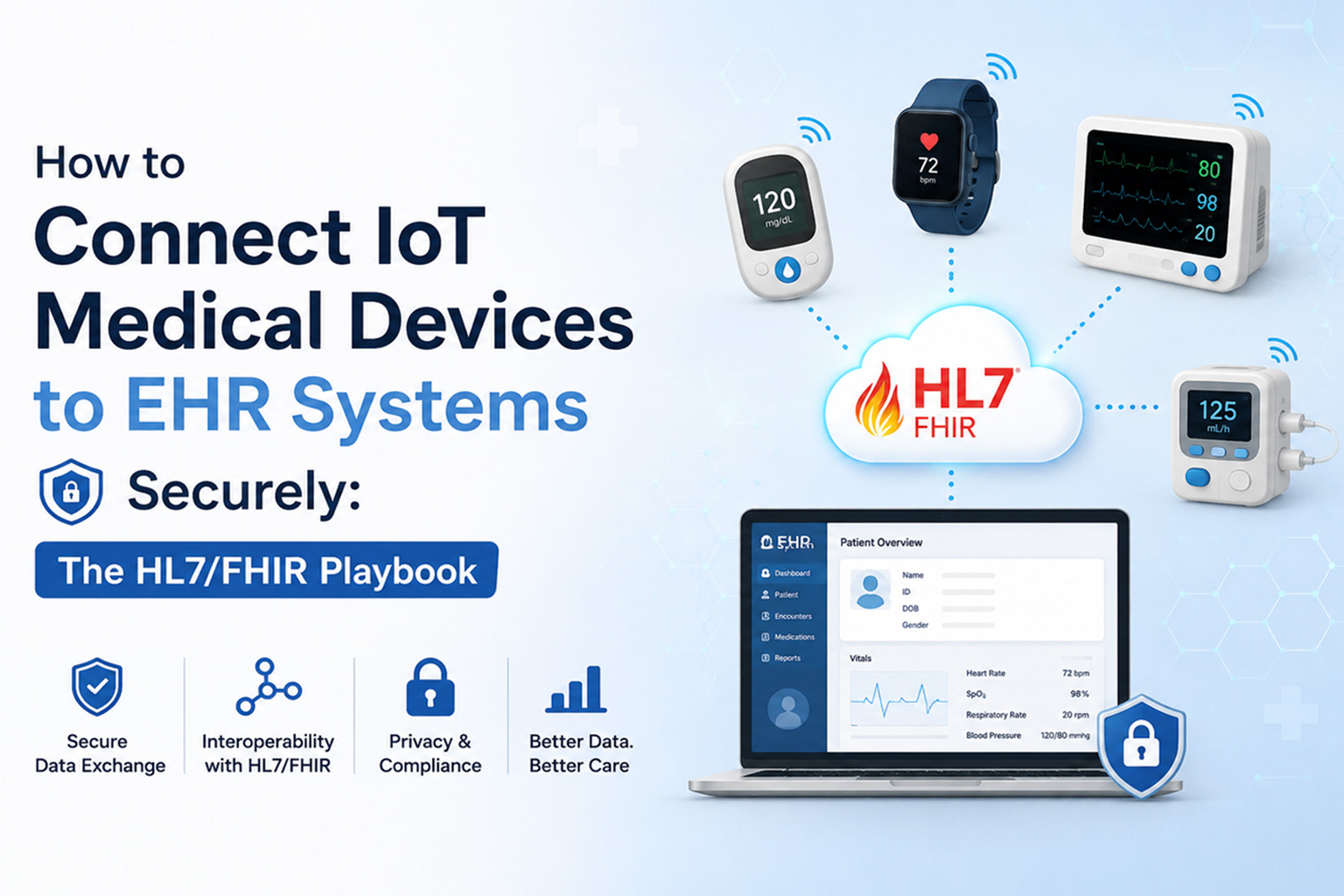
The short answer: medical IoT devices connect to EHR systems by streaming telemetry through secure edge gateways (MQTT/HTTPS), converting that data into HL7 FHIR v4 Observation resources, and pushing it to platforms like Epic and Cerner through SMART on FHIR OAuth 2.0 endpoints, all inside a zero-trust, HIPAA-compliant pipeline. Everything below breaks down exactly how that pipeline is built.
1. The IoMT Dilemma: High-Velocity Telemetry vs. Rigid EHR Schemas
If your team is building a remote patient monitoring (RPM) app, a connected wearable, or any product that needs to connect IoT medical devices to EHR systems, you've probably already run into the same wall every HealthTech engineering lead eventually hits: your devices produce data far faster than a traditional EHR was ever designed to absorb.
The engineering bottleneck. A single ECG patch, glucose monitor, or SPO2 sensor can generate thousands of telemetry points per minute. EHRs, by contrast, are architected around static clinical notes and scheduled updates. Point unthrottled IoT streams directly at an EHR's API and you'll trip rate limits, degrade performance for every other integration on that instance, and eventually get flagged by the vendor.
The security risk. Bluetooth- and cellular-connected edge devices are a favorite target for attackers precisely because they sit outside a hospital's traditional network perimeter. Firmware that transmits unencrypted payloads, or devices that skip mutual authentication, don't just create a data risk; they trigger immediate FDA and HIPAA non-compliance findings the moment an auditor looks at the pipeline.
The fix isn't a bigger EHR server. It's an entirely different architecture, one that treats the EHR as a destination, not a firehose target.
2. Raw Device Streaming vs. Managed FHIR Integration Architecture
Most teams start with the direct-streaming approach because it's the fastest way to get a demo working. It's also the approach that fails a security audit, a payer integration review, or a scale test almost every time. Here's the comparison HealthTech CTOs and VPs of Engineering should be evaluating against before writing a single connector:
|
Architectural Vector |
Direct Unmanaged Streaming (High Risk) |
Managed FHIR IoT Pipeline (NanoByte Standard) |
|
Data Ingestion |
Direct API hits to the EHR (rate-limited, fragile) |
AWS IoT Core / Azure IoT Hub + Kafka stream buffering |
|
Standardization |
Proprietary JSON/CSV schema per device |
Automated payload translation to standard HL7 FHIR v4 |
|
Security & Compliance |
Static device keys, unencrypted payloads |
mTLS authentication, edge PII masking, BAA-covered enclaves |
|
EHR Interoperability |
Custom connector built per EHR vendor |
Universal SMART on FHIR API layer (Epic, Cerner, Athenahealth) |
The pattern in the right-hand column- buffered ingestion, standardized FHIR payloads, mTLS everywhere, and a single universal interoperability layer- is what a genuinely HIPAA-compliant IoT device pipeline for 2026 and beyond actually looks like. It's also the difference between a pipeline that supports one EHR vendor and one that scales across Epic, Cerner, and Athenahealth without a rebuild each time.
3. The 4-Step Technical Architecture for IoMT Data Pipelines
Here's how a managed FHIR IoT pipeline is actually built, step by step:
Step 1: Secure Edge Gateway & Ingestion Layer
Every device certificate is enrolled and rotated automatically, and Mutual TLS (mTLS) is enforced at the gateway. Telemetry is ingested over MQTT or HTTPS into AWS IoT Core or Azure IoT Hub, so no device ever talks to the EHR directly.
Step 2: Stream Processing & Data Sanitization
Raw telemetry passes through Kafka or AWS Kinesis, where it's deduplicated, smoothed to remove sensor noise and spikes, and stripped of patient-identifiable metadata before it moves any further downstream.
Step 3: FHIR Resource Mapping Engine
Purpose-built microservices convert the sanitized JSON into compliant FHIR Observation and DeviceMetric resources, the format Epic, Cerner, and virtually every modern EHR expect for structured clinical data. This is the step most in-house teams underestimate, and it's usually where custom FHIR integration development pays for itself the fastest.
Step 4: SMART on FHIR Authentication & EHR Push
The pipeline authenticates via OAuth 2.0 using the SMART on FHIR framework, then pushes structured vitals, trend summaries, and clinical alerts directly into the provider's existing EHR workflow, no separate portal, no manual re-entry.
4. Frequently Asked Questions
What is the best data standard for medical IoT device integration?
HL7 FHIR (Fast Healthcare Interoperability Resources) v4 is the industry standard. Its RESTful API design and near-universal adoption across major EHR vendors, including Epic and Cerner, make it the safest long-term choice for any team connecting IoT medical devices to EHR systems.
How do you ensure HIPAA compliance when streaming wearable data?
Compliance rests on four pillars: end-to-end encryption (TLS 1.3 in transit, AES-256 at rest), mTLS device authentication, zero-data-retention intermediate buffers, and signed Business Associate Agreements (BAAs) with every cloud provider touching patient data along the way.
How do you stream IoMT data to the Epic FHIR API specifically?
Telemetry is ingested at the edge, translated into FHIR Observation resources, and then pushed through Epic's SMART on FHIR OAuth 2.0 endpoints, which accept structured vitals and device metrics directly into a patient's chart without a proprietary connector.
Should we build this pipeline in-house or bring in outside help?
Teams with an existing DevOps and security bench can build it internally, but the timeline usually runs six to nine months once compliance review is factored in. Most HealthTech companies instead bring in specialists for the FHIR mapping and compliance layer specifically, then keep the rest of the product roadmap in-house.
5. Build Your Scalable, Audit-Ready IoMT Pipeline Today
Device latency, one-off EHR connectors, and the fear of a failed security audit are the three things that quietly stall almost every remote patient monitoring roadmap. None of them are unsolvable; they're just symptoms of skipping the managed FHIR architecture in favor of a quick, direct integration.
If you're evaluating IoT medical device integration services or trying to decide whether to hire remote IoT developers versus building the compliance layer in-house, the fastest path is usually a short technical audit before any code gets written. That's what tells you exactly where your current architecture will break, and what it will take to fix it.
The teams that scale RPM products fastest treat the FHIR mapping and compliance layer as a specialized build, separate from the rest of the product. They keep clinical workflows, patient-facing apps, and provider dashboards in-house, and bring in senior IoT backend and FHIR integration specialists for the pipeline itself, the part where a mistake costs an audit finding, not just a bug ticket.
|
Building a Remote Patient Monitoring App or Integrating Medical IoT Devices? Connect your hardware to Epic, Cerner, and Athenahealth with zero compliance friction. Talk to NanoByte Technologies' HealthTech architects for a free 15-minute Medical IoT & FHIR architecture audit. |


.jpeg)
.jpeg)