
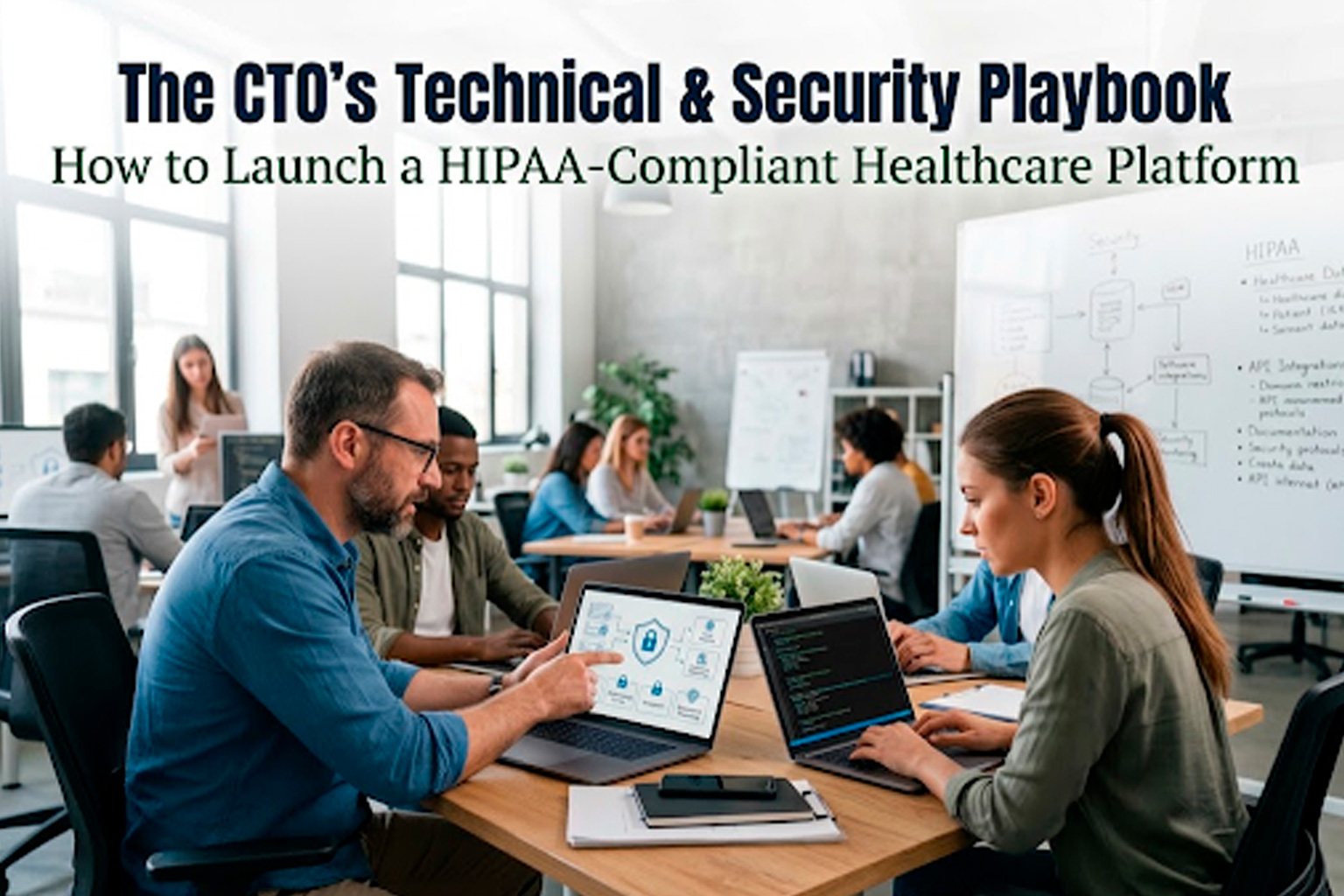
How to Launch a HIPAA-Compliant Healthcare Platform: The CTO's Technical & Security Playbook
26 Aug 2026
A one-time HIPAA fine can run into seven figures, but the higher cost is the healthcare partner, hospital system, or payer who walks away the moment an audit flags a gap. If you're a HealthTech founder or CTO building a digital health app, telemedicine portal, or EHR-integrated platform, knowing how to build a HIPAA-compliant healthcare platform isn't a legal checkbox. It's fundamental to your product architecture, your fundraising pitch, and your enterprise healthcare closes.
Here's a blog that explains the technical and interoperability considerations, as well as infrastructure choices, that make a platform audit-ready, and make it look that way, too, until the next security audit. It's written for founders and engineering leaders who are past the MVP stage and now need their architecture to survive real due diligence from hospital systems, payers, and enterprise buyers.
1. The Healthcare Compliance Reality Check: Beyond Basic Encryption
The high risk: HIPAA non-compliance comes at a cost of $1.9 million or more per violation tier, per year, plus the damage to a hospital system or payer partnership that can result in losing a partnership overnight.
The misunderstanding: If you host your app on AWS or Google Cloud, that doesn't mean it's HIPAA compliant. Cloud providers provide HIPAA-compliant services, but it's up to you to configure, implement and operate the compliance safeguards, administrative controls, physical security policies, and signed Business Associate Agreements (BAAs) with all the different cloud vendors you use, including the database host, email and analytics providers, and all others that might be involved in the handling of your Protected Health Information (PHI).
This discovery is common for most early stage health tech teams during due diligence, when a hospital system's security team requests a SOC 2 report or a signed BAA which has not yet been completed. Creating the architecture right from the start saves on a costly re-platforming project later on.
2. Non-Compliant Web App vs. Production-Grade HIPAA Architecture
Here's what typically separates a prototype healthcare app from a platform that can pass a real compliance audit:
Architecture Layer | Non-Compliant / Basic Setup | Production-Grade HIPAA Architecture |
Data Storage | PHI stored in a general-purpose database with default cloud settings | PHI encrypted at rest (AES-256), keys managed via AWS KMS / HashiCorp Vault |
Vendor Agreements | No signed BAAs with hosting, analytics, or messaging vendors | Business Associate Agreements executed across every vendor touching ePHI |
Access Control | Shared admin logins, no audit trail | Role-based access, unique user IDs, automatic session timeouts, full audit logging |
EHR/EMR Integration | Manual data exports or unsecured point-to-point APIs | HL7/FHIR-based SMART on FHIR pipelines with Epic, Cerner, Athenahealth |
Disaster Recovery | Ad hoc backups, no documented recovery process | Automated encrypted daily backups, sub-1-hour RTO across isolated VPCs |
Monitoring | Reactive — issues found after a breach or complaint | Continuous SAST/DAST scanning plus Datadog/CloudWatch anomaly alerts |
3. The 4 Technical Pillars of a HIPAA-Compliant Engineering Architecture
Pillar 1: Safeguarding ePHI (Protected Health Information)
The best e-PHI security architecture is one that completely separates Personally Identifiable Information (PII) from clinical information. Mature platforms store patient anonymized ID mapping; the connection between patient ID and clinical data is secured by encrypted key vaults like AWS KMS or HashiCorp Vault. Even if one layer is compromised, the data alone would not be sufficient to identify a patient.
Pillar 2: EHR/EMR Integration & Interoperability (HL7 / FHIR Standards)
Any platform that connects with hospital systems must have secure, standards-based API pipelines, and NOT one-off custom integrations. Integrating with Epic, Cerner, and Athenahealth, just as they expect and as they already trust and expect to interact with, is accelerated by an HL7 and FHIR-based approach, specifically using SMART on FHIR protocols.
Pillar 3: Infrastructure Isolation & Disaster Recovery
Production-grade platforms run inside isolated AWS or GCP VPCs, separate from any non-healthcare workloads. Daily backups are scheduled and encrypted, and disaster recovery pipelines are designed to meet a Recovery Time Objective (RTO) of less than one hour; downtime in healthcare is more than a support ticket; it can impact patient care.
Pillar 4: Penetration Testing & Continuous Monitoring
Compliance isn't a one-time certification; it's a posture you maintain. This includes automated SAST/DAST security scanning on every release, regular third-party security assessment and always-on telemetry through tools such as Datadog or CloudWatch, monitoring for suspicious access patterns before they're breaches.
Together, these four pillars form the technical backbone auditors actually look for. The absence of any one of them is typically the source of a routine compliance review becoming a remediation project, such as not integrating with an EHR with SMART on FHIR, or not backing up data encrypted.
Common Questions CTOs Ask Before Building a HIPAA-Compliant Platform
These are the questions that come up most often once a HealthTech team starts scoping a compliant build, based on what enterprise buyers and auditors tend to ask for.
Is AWS or Google Cloud HIPAA-compliant by default?
No. AWS and Google Cloud offer HIPAA-eligible services and will sign a BAA, but compliance depends entirely on how you configure encryption, access controls, logging, and network isolation on top of that infrastructure.
How much does HIPAA-compliant software development cost?
Costs vary widely based on scope, but budgeting for security architecture, HL7/FHIR integration work, and third-party audits from the start is typically far cheaper than retrofitting compliance into an existing platform after a failed assessment.
What is SOC 2 Type II healthcare SaaS compliance, and do I need it alongside HIPAA?
HIPAA is a legal requirement for handling PHI; SOC 2 Type II is a voluntary audit standard that verifies your security controls operate effectively over time. Enterprise healthcare buyers increasingly expect both, since SOC 2 gives them independent assurance beyond your own compliance claims.
How long does it take to become HIPAA-compliant?
A platform built with compliance in mind from the architecture phase can be audit-ready in a few months. Retrofitting compliance onto an existing non-compliant system usually takes considerably longer, since it often means re-architecting data storage and access controls rather than adding a feature.
Do telemedicine apps need the same level of HIPAA compliance as EHR platforms?
Yes. Any platform that transmits, stores, or processes PHI, including video visits, chat, and appointment data in a telemedicine app, falls under the same HIPAA Security Rule requirements as an EHR system, even if it never stores a full medical record.
4. Build Your Scalable, Audit-Ready HealthTech Platform
You don't need to navigate complex healthcare compliance regulations alone, or spend months recruiting specialized local engineers who understand ePHI architecture and FHIR integration. NanoByte Technologies' hipaa compliant software development services connect you with pre-vetted, senior healthcare software engineers and security architects who design audit-ready digital health platforms from the ground up.
Whether you need to hire remote healthcare software developers to extend an in-house team, or you're evaluating a telemedicine app development company to build the entire platform, the goal is the same: architecture that passes the audit the first time, not after a costly rebuild.
5. Launch Your Healthcare Platform with Zero Security Friction
|
Building a Digital Health App, Telemedicine Portal, or EHR Integration Layer? Launch a secure, high-throughput, and audit-ready HIPAA platform. Connect with NanoByte Technologies' HealthTech Engineering Specialists for a Free 15-Minute HIPAA Architecture & Compliance Feasibility Audit. |
.jfif)


.jpeg)