
How to Manage Offshore Software Engineering Pods Without Losing Control
22 Sep 2026
A CTO signs a contract for an offshore engineering pod expecting more capacity and fewer bottlenecks. Three weeks in, Jira tickets sit in "In Progress" for days, pull requests pile up unreviewed, and architectural decisions seem to happen in side conversations nobody wrote down. The internal team spends more time chasing status updates than shipping code.
It's a familiar story, and the instinct is to blame geography or time zones. That's usually the wrong diagnosis. The real issue is almost always operating structure: how work is tracked, reviewed, and owned, not where the engineers happen to be sitting.
Quick Summary: How Do You Retain Control Over Offshore Engineering Pods?
Control over an offshore engineering pod comes from structure, not proximity: clear ownership of each workstream, a shared project board, pull-request-based code review, defined overlap hours, a named technical lead, and delivery metrics everyone can see. There's no single time-zone formula that works for every company; the framework matters more than the schedule.
1. The Offshore Management Dilemma: Autonomy vs. Oversight
The Micromanagement TrapDaily check-ins on every ticket feel like control, but they usually produce the opposite. Constant status requests interrupt focused engineering work, and developers start optimizing for "looking busy" in Slack rather than solving the actual problem. Context-switching has a real cost, and a pod that's answering status questions all day isn't writing much code.
The Black-Box Problem
The other failure mode is handing over a specification and checking back in three weeks later. By then, assumptions have hardened into code, and any misunderstanding about scope or architecture is now expensive to unwind. Without intermediate checkpoints, a mid-sprint demo, a design review, an early pull request, problems surface only once they're baked into the codebase.
Why the Pod Model Helps
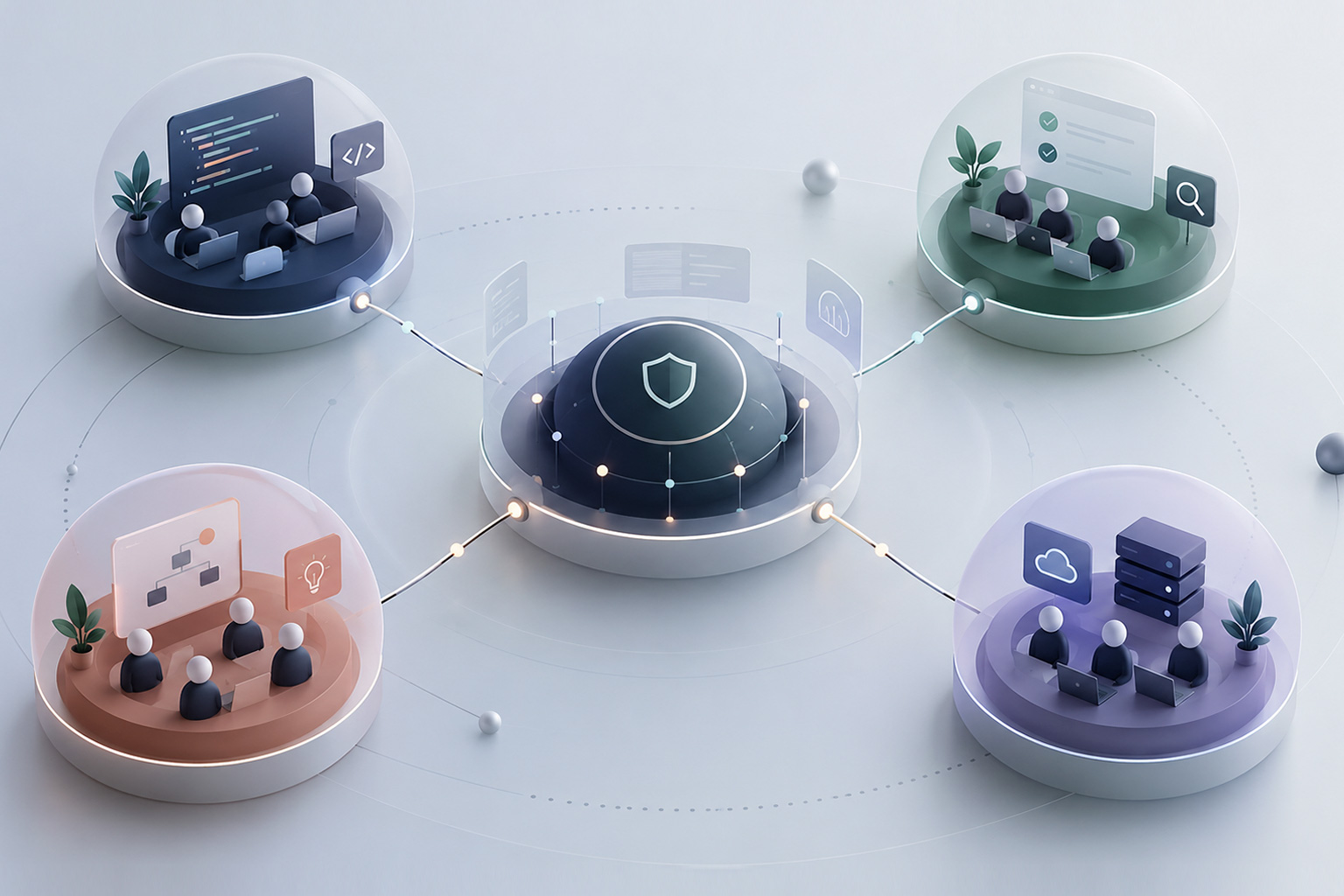
A software engineering pod sits between these two extremes. Instead of a loose group of individual contractors reporting up separately, a pod is a small, cross-functional delivery unit with its own internal accountability: typically, a technical or engineering lead, one or more full-stack or specialized engineers, a QA engineer, and DevOps support where the project calls for it. That structure isn't mandatory for every engagement; a single specialist hired to fill a narrow skills gap doesn't need a pod around them, but for anything resembling a product workstream, a pod gives the client a single point of technical ownership instead of several separate relationships to manage.
2. Traditional Outsourcing vs. Embedded Offshore Engineering Pods
Traditional outsourcing isn't inherently worse than an embedded pod model; plenty of well-run vendor engagements deliver good outcomes. What differs is where visibility and ownership sit by default.
|
Management Area |
Traditional Outsourcing Model |
Embedded Engineering Pod |
|
Workflow |
Vendor-managed process |
Shared internal workflow |
|
Project Tracking |
Separate reporting |
Shared Jira / project board |
|
Code Delivery |
Milestone-oriented |
Continuous pull requests |
|
Communication |
Scheduled updates |
Integrated team communication |
|
Code Review |
Often at delivery checkpoints |
Part of everyday development |
|
Technical Ownership |
Often separated from client team |
Clearly assigned within the pod |
|
Quality |
Can become reactive |
Testing and review integrated into workflow |
The table describes tendencies, not guarantees. A traditional vendor relationship with strong governance can outperform a poorly run pod. The engagement model matters less than the people, the process discipline, and how much of the workflow is actually shared.
2. The Four Operational Pillars for Managing Offshore Engineering Pods
Pillar 1: Build a Communication System, not a Meeting CalendarMeetings alone don't create alignment; a standing structure does. That usually means a short daily or near-daily standup, defined overlap hours for live collaboration, async written updates for everything else, and documentation that survives after the conversation ends. A recorded Loom walkthrough of a tricky bug fix often communicates more than a live call, because it doesn't require both sides to be awake at once.
How much overlap you need depends on the locations, the pod's seniority, and how much real-time collaboration the work actually requires; there's no single number that fits every engagement. What matters more is a working principle: use overlapping hours for collaboration, planning, reviews, and unblocking, and protect the rest for focused work. Teams that get this backwards end up "online" at the same time without really talking, or interrupted constantly with no deep work getting done.
Escalation paths matter just as much as routine communication. When something breaks in production at 2 a.m. local time for the internal team, the pod needs a clear, pre-agreed path to reach someone, not a guessing game about who's awake.
Pillar 2: Make Code Quality Visible
Git history is one of the most honest sources of truth an engineering leader has. Pull requests, branch protection rules, and CI checks turn code quality from something you have to take on faith into something you can actually see. GitHub's branch protection settings, for example, let a repository require a minimum number of approving reviews before a pull request can merge into a protected branch, and can dismiss stale approvals automatically when new commits change the diff, which means a merged change has, by definition, passed review, not just been submitted for it.
Layer automated testing, static analysis or linting, and a written definition of done on top of that, and code quality becomes something you can point to rather than something you have to trust. None of this requires an engineering leader to watch developer’s type. It requires the review and testing process itself to be structural rather than optional, the same standard a strong internal team would already hold itself to.
Pillar 3: Give Everyone One Source of Truth
Split project tracking- one board for the internal team, a different spreadsheet or status doc for the offshore pod- is where duplicate work, ambiguous ownership, and hidden blockers usually start. A single shared Jira (or equivalent) instance, with clear user stories, acceptance criteria, named assignees, and visible sprint goals, removes most of that friction by making status a fact rather than an opinion.
This is also where agile workflows for offshore dev teams tend to succeed or fail. A backlog that's genuinely shared, refined together, and prioritized against the same roadmap keeps a pod pulling in the same direction as the internal team instead of working from a stale interpretation of it.
Pillar 4: Put Technical Leadership Inside the Pod
Product requirements rarely translate cleanly into engineering tasks on their own. A dedicated technical or engineering lead inside the pod, someone who understands both the architecture and the business context, is what turns a requirements document into a sound implementation plan, without every decision routing back through the client's internal leadership.
This is also the case for companies that want to hire remote engineering leads specifically, rather than build a leadership layer from scratch: an experienced lead already knows how to run code review standards, break down technical debt conversations, and flag architectural risk before it becomes expensive. Done well, that role is a bridge between product and implementation, not an extra layer of bureaucracy standing between the client and the work.
3. How Do You Manage Remote Software Engineers Across Time Zones?
Managing engineers across time zones works best when the team maps out overlap windows deliberately, relies on written async updates and documentation for handoffs, keeps meetings to what genuinely needs real-time discussion, and has a clear, tested escalation path for anything urgent.
Time-zone difference is often treated as a pure liability, but structured well, it can support something closer to continuous progress: a U.S.-based product team wraps up its day with a written handoff- what shipped, what's blocked, what needs a decision- and an offshore pod picks that work up at the start of its own day, resolving straightforward blockers before the U.S. team is even back online. The reverse handoff happens the next morning.
That only works if the handoff itself is disciplined: specific, written, and tied to actual tickets rather than a vague "let's sync tomorrow." Teams that skip the documentation step usually end up with duplicated work or a full day lost waiting for a clarifying question to get answered. None of this guarantees a productivity gain; it depends heavily on how well-defined the work is and how mature the pod's habits are, but the underlying mechanism, when it's set up properly, is real.
4. What Should CTOs Measure?
Hours logged or "online" status in a chat tool say almost nothing about whether a pod is actually delivering. Outcome-based metrics do a better job, and the DORA (DevOps Research and Assessment) research program, now part of Google Cloud, has become something close to an industry standard for defining them: deployment frequency, lead time for changes, change failure rate, and time to restore service after an incident.
● Sprint completion rate
● Pull-request cycle time (how long a PR sits before review and merge)
● Deployment frequency
● Change failure rate and defect trends
● Rework and code review turnaround time
● Lead time for changes, from commit to production
● Blocked-work volume and how long items stay blocked
No single metric proves a pod is performing well, and chasing one in isolation tends to distort behavior; optimizing purely for deployment frequency can quietly push change failure rate up. These numbers are most useful read together, over several sprints, against what the team is actually building.
5. When Does an Offshore Engineering Pod Make Sense?
An embedded pod isn't the right model for every situation, but it tends to fit well in a specific set of circumstances:
● Scaling an existing engineering team without a long internal hiring cycle
● Standing up a new product where speed to a working version matter
● Adding a specialized skill set, mobile, DevOps, a particular framework, that the internal team doesn't have
● Supporting a long-term roadmap that needs sustained capacity, not a one-off project
● Filling a temporary capability gap during a transition or a hiring freeze
● Maintaining or modernizing an existing system without pulling the internal team off new feature work
Companies exploring this route are usually comparing a few options: traditional outsourcing, hiring a dedicated offshore development team member by member, or managed IT staff augmentation through a vendor that assembles and supports the pod. Offshore agile development services and managed dedicated developer pods describe roughly the same idea: capacity that plugs into an existing workflow rather than running as a separate, parallel process. Which one fits depends less on the label and more on how much internal bandwidth exists to manage the relationship.
Frequently Asked Questions
How do you handle time-zone differences when managing offshore developers?Map out where real overlap exists and reserve it for live collaboration, planning, reviews, and unblocking. Everything else moves to written async updates and documentation. Structured handoffs at the end of each team's day, tied to specific tickets, let work continue rather than stall overnight.
What key metrics should I track to measure an offshore engineering pod?
Track outcome-based metrics rather than hours online: pull-request cycle time, deployment frequency, change failure rate, lead time for changes, and sprint completion. Read them together over several sprints rather than treating any single number as proof of performance.
What is an offshore software engineering pod?
A pod is a small, cross-functional delivery unit, typically a technical lead, one or more engineers, a QA engineer, and DevOps support where needed, that owns a workstream end to end, rather than a loose group of individual contributors reporting up separately.
How do I maintain code quality with an offshore development team?
Make review structural: branch protection rules, required pull-request approvals, automated testing and CI checks, and a written definition of done. Quality becomes visible in the Git history instead of something you have to take on trust.
Is offshore staff augmentation the same as outsourcing?
Not quite. Staff augmentation adds engineers who work inside the client's own workflow, tools, and processes. Traditional outsourcing typically hands off a scope of work to a vendor-managed process with its own separate tracking and checkpoints.
Build and Scale Engineering Pods with Confidence
None of this requires choosing between engineering capacity and control. The two aren't in tension; the real tension is between an unstructured engagement and a structured one. A pod that shares your project board, follows your code review standards, and reports the same delivery metrics as your internal team behaves like an extension of it, not a black box you're hoping will deliver.
NanoByte Technologies builds and staffs engineering pods around that model: dedicated developers, technical leads, and QA working inside the client's existing tools and workflows, rather than bolted on from the outside. That's the practical shape of managed IT staff augmentation capacity that plugs into how your organization already works, with clear technical ownership from day one.
Struggling with offshore code quality, communication, or team alignment? Talk to NanoByte Technologies about structuring an engineering team that fits your existing workflows, technical requirements, and delivery model. Partner with NanoByte Technologies.
.png)
.png)
.jpeg)