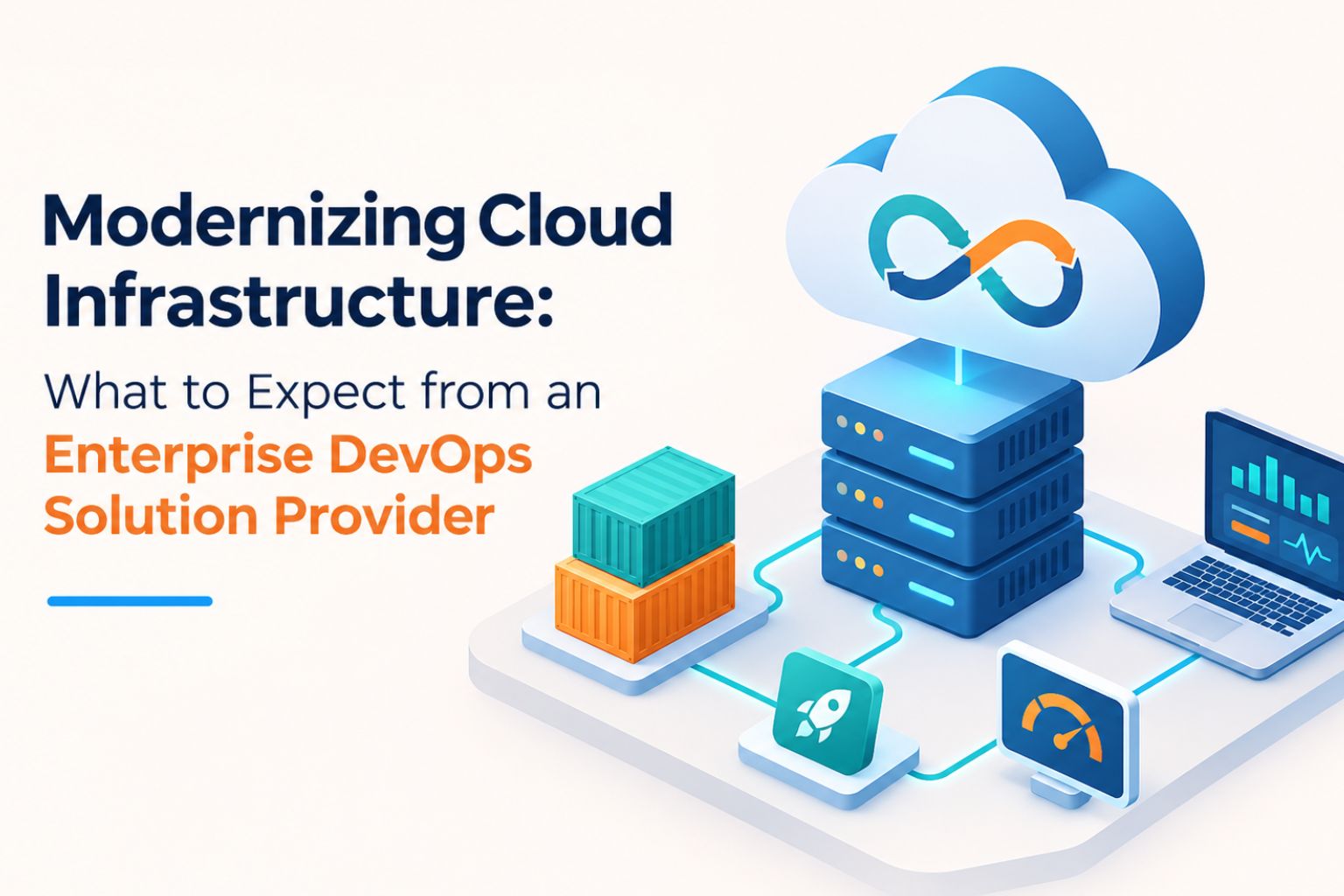
Modernizing Cloud Infrastructure: What to Expect from an Enterprise DevOps Solution Provider
04 Nov 2026
Introduction: The Cloud Modernization Wall
Most growing engineering organizations hit the same wall. AWS and GCP bills climb faster than traffic, and data-transfer charges nobody budgeted for appear. Environments that were once identical drift apart because someone fixed something in the console at 2 a.m. Pipelines that finished in ten minutes now take forty, so developers wait instead of shipping. Deployments feel riskier, security reviews happen late, and observability gaps mean incidents are diagnosed by guesswork.
The instinctive response is to buy another tool. Tools help, but without a coherent infrastructure strategy they add integration overhead and more places for configuration to diverge. Lasting improvement comes from architecture, process, and ownership, which is why many CTOs and Heads of SRE evaluate an enterprise DevOps solution provider rather than simply expanding the toolchain.
Quick Summary: What Does an Enterprise DevOps Solution Provider Actually Do?
An enterprise DevOps solution provider assesses your cloud environment, then modernizes and automates it using Infrastructure as Code, CI/CD pipelines, and Kubernetes optimization. It also embeds DevSecOps controls, FinOps cost governance, and observability, so delivery becomes faster, more consistent, and easier to operate.
Why In-House DevOps Can Become a Scaling Bottleneck
In-house DevOps teams are rarely the problem; the operating model often is. As services and cloud accounts multiply, practices that suited a ten-service system strain a hundred-service one. These problems can appear even with highly experienced engineers when infrastructure practices do not evolve alongside the product.
Manual Provisioning Debt
Every console change that is not captured in code becomes debt. Over time it produces configuration drift, so a release that passes in staging behaves differently in production and nobody can fully explain why. Disaster recovery then rests on tribal knowledge.
- Console-based changes with no review trail
- Drift between development, staging, and production
- Inconsistent deployments and hard-to-reproduce environments
- No version-controlled history of infrastructure changes
Developer Velocity Bottlenecks
Pipelines grow by accretion. Stages are added and rarely removed, and the result is a long feedback loop that quietly taxes every engineer, every day. The causes are usually fixable, but fixing them takes focused engineering time that product teams rarely have.
- Slow, serial build and test stages
- Inefficient Docker image builds that invalidate cache layers early
- Limited parallel execution
- Poor caching and unnecessary pipeline stages
Basic Cloud Support vs. Enterprise DevOps Solution Architecture
The table below compares two general approaches. It reflects common industry practice, not any specific implementation or client environment.
|
Capability |
Basic Cloud Support |
Enterprise DevOps Approach |
|
Infrastructure deployment |
Manual changes and basic scripts |
Version-controlled Infrastructure as Code |
|
Deployment strategy |
Risk-prone releases |
Progressive delivery, blue/green, or canary where suitable |
|
Cloud cost governance |
Reactive billing reviews |
Continuous FinOps analysis and optimization |
|
Security |
Separate manual checks |
Integrated DevSecOps controls |
|
Observability |
Basic uptime monitoring |
Metrics, logs, traces, and service-level visibility |
|
Kubernetes management |
Reactive cluster maintenance |
Resource optimization, scaling, and security controls |
Not every row applies to every organization; progressive delivery, for example, suits some services better than others.
The Four Pillars of Enterprise Cloud Transformation
Pillar 1: Declarative Infrastructure as Code
Terraform or OpenTofu lets teams describe infrastructure declaratively, store it in Git, and apply changes through reviewed pull requests. Reusable modules encode approved patterns, and code review adds a control point that console changes never had. GitOps tools such as Argo CD or Flux extend the model to Kubernetes by continuously reconciling cluster state with what is declared in a repository.
IaC reduces configuration drift but does not eliminate it automatically. Out-of-band changes and emergency fixes still happen, so drift detection, policy governance, restricted console permissions, and a controlled change process remain necessary. Adoption can be incremental, importing existing resources gradually.
Pillar 2: High-Velocity CI/CD Optimization
Effective enterprise CI/CD pipeline automation typically combines several techniques:
- Build graph optimization, so only affected components rebuild
- Docker layer caching, with instructions ordered for cache reuse
- Parallel test execution and test sharding
- Efficient, right-sized CI runners
- Artifact reuse across stages and pipelines
- Pipeline security and quality gates placed where they add signal
These techniques can shorten build times and tighten feedback, but results depend on the existing pipeline, test suite, and workload. A credible provider baselines queue time, build duration, and failure rate first, then verifies every change against that baseline. Caching and artifact reuse can also reduce repeated downloads of large dependencies and images, which is how enterprise DevOps automation helps trim both build times and avoidable data transfer.
Pillar 3: Kubernetes Cost and Security Optimization
Kubernetes infrastructure optimization starts with how workloads declare resources. CPU and memory requests drive scheduling and node counts, while limits cap consumption; set poorly, they create either waste or throttling and out-of-memory kills. Right-sizing from observed utilization, combined with horizontal and vertical scaling and cluster autoscaling where the workload suits them, improves node utilization. Not every workload benefits from autoscaling or the same configuration; stateful, latency-sensitive, and batch workloads each need different settings.
Network architecture is another frequent cost driver. On AWS, NAT Gateways charge for both hourly availability and data processed, so heavy traffic from private subnets to services such as S3 can become expensive. VPC endpoints can help when traffic to supported AWS services is routed through them; gateway endpoints cover S3 and DynamoDB, while interface endpoints carry their own hourly and data-processing charges, so the economics depend on traffic patterns. They do not eliminate all egress, NAT Gateway, or cross-AZ data-transfer charges, which call for separate topology analysis. AWS, Azure, and GCP also use different pricing models and offer different optimization options, so each cloud needs its own analysis.
Security belongs in the same conversation: least-privilege RBAC, network policies, Pod Security Standards, image scanning, and workload isolation reduce blast radius and work best when designed alongside cost decisions.
Pillar 4: Automated Observability and Incident Response
Observability makes production behavior queryable. Prometheus and Grafana remain a common foundation for metrics and dashboards, while OpenTelemetry provides vendor-neutral instrumentation for metrics, logs, and traces. Distributed tracing shows which dependency is driving latency, and service-level indicators and objectives give teams a shared definition of healthy.
Alert quality matters as much as coverage: alerts tied to SLO burn rates, backed by runbooks and clear escalation paths, reduce noise and shorten response. Where the added complexity is justified, eBPF-based tooling can provide kernel-level network and runtime insight. Observability supports faster diagnosis, but it does not guarantee that incidents will be prevented.
How to Choose the Right Enterprise DevOps Solution Provider
Judge a cloud infrastructure consulting agency on engineering depth rather than rate cards. The same checklist applies whether you plan to hire DevOps engineers through a specialist company or bring in a partner for a defined initiative:
- Experience with enterprise cloud architecture
- Infrastructure as Code and GitOps expertise
- CI/CD engineering and release strategies
- Kubernetes operations and optimization
- Cloud cost visibility and FinOps practices
- Security integration and access governance
- Monitoring, incident response, and documentation
- Knowledge transfer and long-term maintainability
Hourly rates are easy to compare and a poor proxy for value. A lower-rate team that leaves behind undocumented, hand-built infrastructure creates more cost than it saves, while a stronger team leaves reusable modules, runbooks, and internal capability. Ask how they baseline before optimizing and how ownership is handed over. If you plan to hire senior DevOps architects, or outsource DevOps infrastructure management long term, probe how they work, not only what they charge. For cost work, look for AWS FinOps infrastructure consultants who can explain trade-offs rather than quote a savings estimate.
Frequently Asked Question
Q1: How does a specialized DevOps solution provider reduce enterprise AWS or GCP bills?
It starts with utilization analysis to find idle and oversized resources, then right-sizes compute, applies storage lifecycle policies, and selects suitable purchasing options such as savings plans, committed use discounts, or spot capacity. Kubernetes optimization and network or data-transfer analysis address the remaining drivers. Savings vary with workload, architecture, existing utilization, and contractual commitments, so optimization should be a measured process, not a promised percentage.
Q2: Can DevOps modernization happen without stopping active feature development?
Usually, when it is phased. Providers commonly run parallel environments, adopt IaC incrementally, and use controlled rollouts such as canary releases. This reduces disruption but does not remove it: database migrations or network redesigns may still require maintenance windows, extra testing, or coordinated releases.
Q3: What should enterprises expect from an enterprise DevOps solution provider in 2026?
Expect an assessment of architecture, pipelines, cost, and security; an architecture plan with prioritized milestones; automation through IaC and CI/CD; DevSecOps controls; FinOps reporting; observability tied to service-level objectives; documentation and knowledge transfer; and continuous improvement against measured baselines.
Q4: When should a company hire senior DevOps architects instead of expanding its internal team?
When the problem is architectural rather than a capacity gap: multi-account complexity, Kubernetes at a scale where design choices compound, cost problems with unclear causes, CI/CD bottlenecks that resist incremental fixes, or a time-bound need for specialist skills. If the need is steady operational capacity, hiring internally may fit better.
Modernize Your Cloud Infrastructure with NanoByte Technologies
NanoByte Technologies positions itself as a technology partner for organizations looking to improve cloud infrastructure, DevOps workflows, automation, and engineering scalability. Relevant service areas include:
- Cloud infrastructure consulting
- DevOps engineering and CI/CD automation
- Infrastructure as Code
- Kubernetes infrastructure optimization
- Cloud cost optimization and FinOps
- DevSecOps and infrastructure security
- Ongoing infrastructure management and engineering support
The right starting point is a conversation about your current architecture, constraints, and goals. If you are evaluating an enterprise DevOps solution provider, NanoByte can discuss where a phased approach would fit.
|
Modernize Your Cloud Infrastructure with the Right Engineering Partner Slow deployments, rising cloud costs, and fragile infrastructure can hold back your engineering roadmap. Partner with NanoByte Technologies to explore a more scalable, secure, and efficient approach to cloud infrastructure and DevOps. Partner with NanoByte Technologies. Website: https://www.nanobytetechnologies.com |