
Real-World Smart Automation Use Cases That Deliver Measurable ROI
.png)
27 Feb 2026
Enterprises today operate in an environment where efficiency, accuracy, and speed directly impact competitiveness. As digital transformation accelerates, organizations are increasingly investing in smart automation use cases that deliver measurable business value. Smart automation is no longer limited to reducing manual effort; it enables intelligent decision-making, predictive insights, and scalable operations.
When implemented strategically, intelligent automation in business produces clear and trackable outcomes. Companies gain productivity, transparency, compliance, and cost savings. These measurable results make smart automation a top investment priority.
| Industry |
Automation Impact |
ROI Example |
| Finance |
Faster invoice processing |
30% reduction in manual errors |
| Manufacturing |
Predictive maintenance |
15% less downtime |
| Retail |
Personalized recommendations |
10–15% higher conversion |
Understanding Smart Automation in Enterprises
Smart automation combines technologies such as artificial intelligence, robotic process automation, advanced analytics, and workflow orchestration. Unlike traditional automation that follows fixed rules, intelligent systems can analyze data, learn patterns, and trigger adaptive workflows.
Modern automation solutions for enterprises are designed to integrate with existing ERP, CRM, and operational systems. This ensures that automation does not function in isolation but enhances overall enterprise performance. As a result, organizations gain real-time visibility and improved operational agility.
Enterprise Automation Example: Finance & Accounting Automation
One of the most impactful smart automation use cases is in finance operations. Enterprises manage thousands of invoices, expense reports, reconciliations, and compliance requirements daily.
Use Case: Accounts Payable Automation
Through AI-powered invoice recognition and RPA-driven workflow processing, organizations automate:
- AI-powered invoice recognition
- Validation against purchase orders
- Automated approval routing
- Scheduled payments
- Digital audit trails
Measurable ROI from Automation
Companies implementing business process automation services in finance report:
- Reduced processing time
- Fewer manual errors
- Improved compliance tracking
- Lower operational costs
- Faster vendor payments
Automation cost savings examples in finance often stem from eliminating repetitive manual entry and minimizing late payment penalties.
Manufacturing: Predictive Intelligence and Operational Stability
Every year, businesses lose billions to inefficiency, but smart automation is turning wasted hours into measurable ROI.
With IoT-enabled monitoring and AI-driven analytics, enterprises now shift from reactive maintenance to predictive maintenance strategies. Machines continuously transmit performance data, allowing systems to detect irregular patterns before breakdowns occur.
Industrial automation consulting providers help manufacturers integrate these intelligent monitoring systems with production workflows. The result is improved asset utilization, optimized maintenance schedules, and enhanced safety standards.
In real-world automation examples with ROI, manufacturers report reduced downtime and better production planning. This directly strengthens operational resilience and long-term profitability.
Customer Service: Intelligent Support at Scale
Customer experience has become a major differentiator in competitive markets. Intelligent automation in business plays a critical role in enhancing service efficiency without proportionally increasing staffing costs.
AI-driven chatbots and automated ticketing systems handle routine queries, provide instant responses, and route complex issues to the appropriate departments. By integrating these tools into broader enterprise automation solutions, companies maintain consistent service quality while reducing response times.
The smart automation ROI in customer service is visible through improved customer satisfaction and reduced operational expenses. Automation success stories in enterprises consistently highlight how intelligent support systems free human agents to focus on higher-value interactions.
Human Resources: Streamlining Talent Management
HR departments manage recruitment, onboarding, payroll coordination, and compliance documentation. Manual processing often slows hiring cycles and increases administrative burdens.
Business process automation services now enable organizations to automate resume screening, interview scheduling, and onboarding documentation workflows. Intelligent systems evaluate candidate data, match skills with job requirements, and trigger communication sequences automatically.
A trusted RPA implementation company can design HR automation frameworks that integrate seamlessly with existing applicant tracking platforms. The measurable ROI from automation in HR includes faster hiring decisions, reduced manual workload, and improved data accuracy. These automation success stories in enterprises illustrate how HR evolves from administrative support to strategic workforce planning.
Supply Chain Optimization: Enhancing Visibility and Control
Supply chain complexity requires accurate forecasting and responsive decision-making. Traditional manual planning methods struggle to adapt to rapid demand fluctuations.
With AI automation services, enterprises automate demand forecasting, inventory management, and route optimization. Predictive models analyze historical data and market patterns to anticipate inventory needs. Automated systems then trigger procurement and distribution workflows accordingly.
Digital transformation consulting experts often guide organizations in aligning these systems with enterprise resource planning platforms. As a result, businesses gain better inventory control and reduced carrying costs.
Real-world automation examples with ROI in supply chain operations show improvements in delivery timelines and working capital management. The ability to make proactive decisions strengthens overall competitiveness.
Healthcare Operations: Accuracy and Compliance
Healthcare organizations handle vast amounts of sensitive data and regulatory requirements. Claims processing and patient administration can become time-consuming without automation.
Through intelligent automation in business, healthcare providers streamline claims validation and documentation workflows. Automated systems verify policy details, cross-check coding accuracy, and maintain digital compliance records.
The measurable ROI from automation includes faster claims approvals, fewer administrative errors, and improved regulatory adherence. These automation cost savings examples also demonstrate enhanced patient experience through reduced processing delays.
Retail and eCommerce: Data-Driven Personalization
Retail enterprises rely heavily on customer insights and inventory management. Smart automation use cases in retail often focus on personalization and pricing optimization.
AI-powered systems analyze customer behavior patterns and automatically adjust marketing campaigns, recommendations, and pricing strategies. Inventory synchronization ensures stock levels align with demand forecasts.
Enterprise automation examples in retail show measurable ROI through improved conversion rates and optimized inventory turnover. Automation enhances decision-making speed while maintaining operational efficiency.
Measurable ROI from Automation
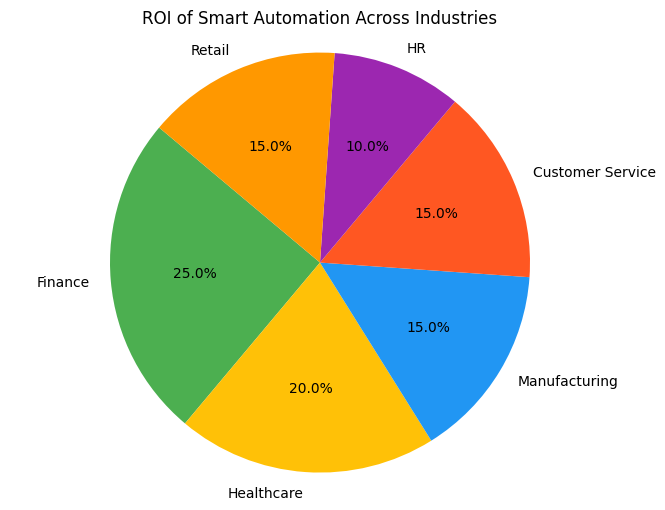
The return on investment (ROI) from smart automation is a crucial factor for businesses as they decide where to invest in technology. Automation not only reduces manual labor but also drives efficiencies that are measurable and impactful across industries.
The following chart illustrates how different sectors are benefiting from smart automation. As companies adopt intelligent automation solutions, they experience improvements in key areas such as cost reduction, operational efficiency, and process optimization.
How to Maximize Smart Automation ROI
To ensure measurable ROI from automation, enterprises should:
- Identify high-volume repetitive processes
- Measure baseline performance metrics
- Define clear automation objectives
- Select the right RPA implementation company
- Integrate AI with existing enterprise systems
- Continuously monitor performance improvements
Successful automation success stories in enterprises share one common factor: strategic implementation rather than isolated technology deployment.
Conclusion
Smart automation use cases are delivering measurable ROI across industries by improving efficiency, accuracy, and scalability. From finance and manufacturing to healthcare and retail, real-world automation examples with ROI demonstrate how intelligent automation in business creates sustainable competitive advantages.
Enterprises investing in automation solutions for enterprises are not merely reducing manual work; they are building resilient, data-driven organizations prepared for long-term growth. With the support of industrial automation consulting, digital transformation consulting, and expert RPA implementation companies, businesses can unlock significant operational value and achieve consistent smart automation ROI.
As competition intensifies, enterprises that strategically adopt intelligent automation will lead the way in operational excellence and innovation.
Ready to transform your operations? Contact NanoByte Technologies to unlock smart automation ROI for your enterprise
.jfif)
.jfif)
.jfif)