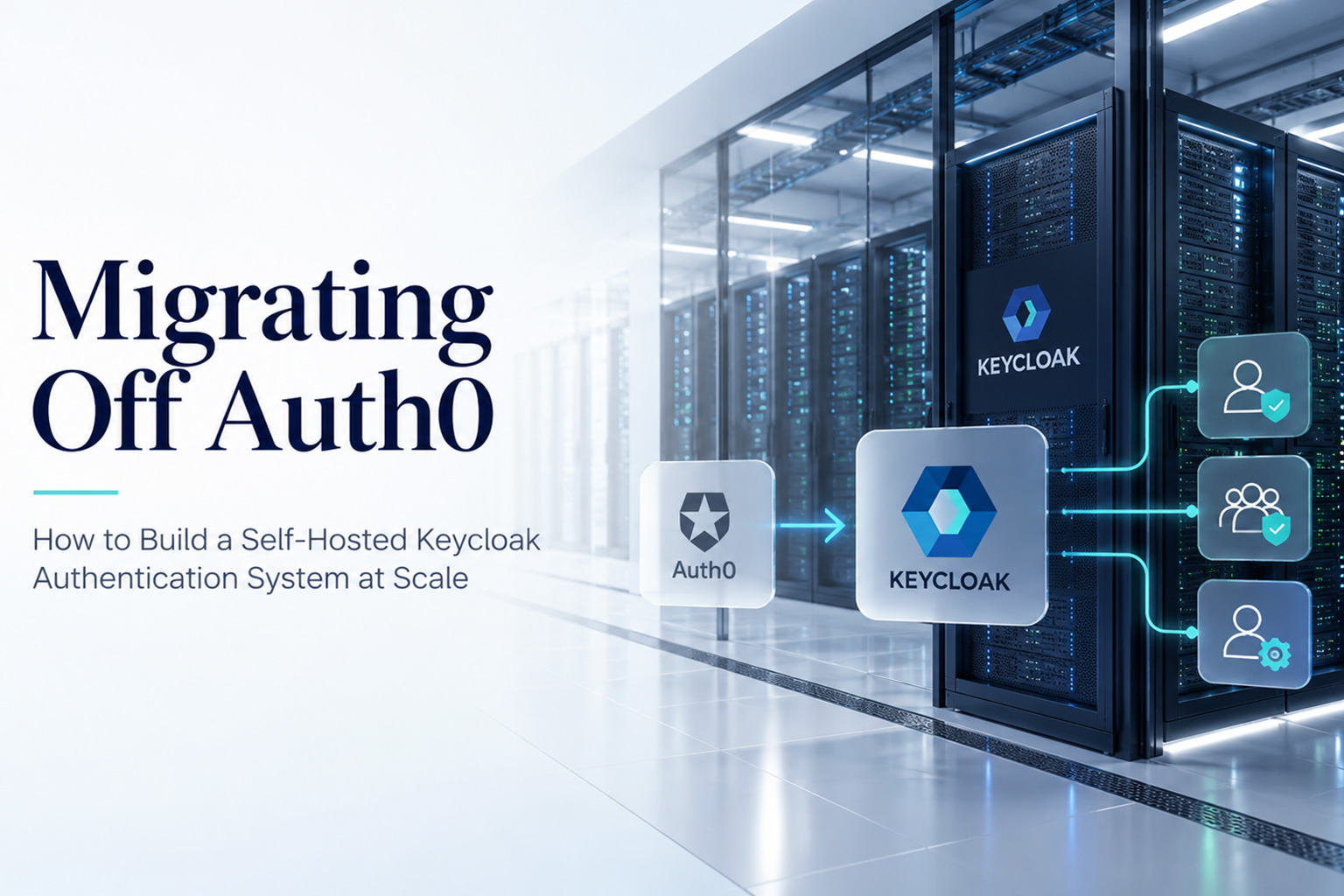
Migrating Off Auth0: How to Build a Self-Hosted Keycloak Authentication System at Scale
30 Oct 2026
Many enterprises now search for an auth0 to keycloak migration guide because identity has become both a cost line and a dependency risk. Self-hosted Keycloak can return control over data location and extensibility, but it moves availability, patching, and security operations onto your teams.
Quick Summary: How Do You Migrate from Auth0 to Keycloak Without User Friction?
Prepare a highly available Keycloak environment, map Auth0 clients, tokens, and custom logic, choose a credential strategy (hash import, lazy migration, or password reset), then cut over in monitored pilot phases with rollback. Some password resets may still be required.
1. The SaaS Identity Tax: Why Enterprises Outgrow Auth0
The MAU Pricing Challenge
Managed providers, Auth0 included, generally price by monthly active users (MAUs), layered with plan tiers and contract terms. Identity cost therefore tracks user activity rather than infrastructure consumed, which deserves regular review for consumer products with large audiences or B2B platforms adding tenants quickly. Model your own quote rather than relying on generic examples.
The right comparison is total cost of ownership. Self-hosting removes per-user licensing where applicable, but compute, database, backups, security reviews, upgrades, on-call coverage, and engineering time remain.
Data Sovereignty and Customization
Regulated industries and regional privacy rules may require control over where identity data lives. Private-cloud or on-premises deployment provides that, though Auth0’s deployment and contractual options should be checked first, since they may already satisfy the requirement.
Customization is the second driver. Keycloak exposes service provider interfaces (SPIs) for authenticators, user storage, event listeners, and protocol mappers. The trade-off is responsibility: your team owns patching, hardening, key management, monitoring, and incident response, and every extension is code you maintain through upgrades.
2. Auth0 SaaS Model vs. Self-Hosted Keycloak
Auth0 trades control for operational simplicity; Keycloak trades operational simplicity for control.
|
Engineering factor |
Auth0 SaaS |
Self-hosted Keycloak |
|
Pricing structure |
Subscription and usage-based pricing, depending on plan |
Infrastructure and operational costs |
|
Infrastructure control |
Managed identity service |
Customer-managed deployment |
|
Data residency |
Depends on available Auth0 deployment and contractual options |
Greater deployment-location control |
|
Customization |
Platform-supported extensibility |
Custom extensions and supported integrations |
|
High availability |
Managed service availability |
Requires customer-designed HA architecture |
|
User migration |
Depends on supported export and migration mechanisms |
Requires planned import or migration strategy |
|
Maintenance |
Provider-managed platform operations |
Customer-managed updates, monitoring, and security |
3. The Engineering Blueprint for Auth0-to-Keycloak Migration
Treat the migration as four phases, each with exit criteria.
Step 1: Design and Deploy a High-Availability Keycloak Architecture
Keycloak can be deployed on Kubernetes with the official Keycloak Operator, which its own high availability guides use; confirm the Operator release matches your Keycloak version. A typical design runs multiple pods behind a load balancer with readiness and liveness probes, PostgreSQL as the persistent database, and embedded Infinispan caching for distributed state. Spread pods across availability zones, and plan backups, tested restores, monitoring, and capacity testing early.
Multi-AZ high availability and multi-region resilience are different problems. One cluster spanning availability zones tolerates a zone failure, though the Kubernetes control plane remains a single point of failure. For independent clusters, Keycloak documents multi-cluster deployments (v2), which need no external Infinispan cluster; the older v1 approach is deprecated.
Those guides target a single region or an equivalent low-latency setup. They require a synchronously replicated database with commit latency below 10 ms, synchronized clocks, and an external load balancer probing health endpoints. Cross-site caching alone therefore does not create a multi-region solution. Distant active-active designs add replication lag and failover complexity beyond what Keycloak documents, so treat them as custom engineering with failure and load testing.
Step 2: Plan User and Credential Migration
Separate the data types first, because each migrates differently. Profiles and metadata can usually come from Auth0’s bulk user export and load through Keycloak’s Admin API or realm import. Passwords, MFA, social identities, and sessions each need their own plan.
Auth0’s standard export tools do not include password hashes for Auth0-hosted database users; its documentation says they can be requested through a support case, with availability possibly depending on your plan. Even then, Keycloak can verify hashes only if the algorithm maps to a supported or custom password hash provider. It ships Argon2 and PBKDF2 variants and accepts custom providers through its SPI, so test real samples.
When hashes cannot be obtained or mapped, alternatives are conditional. A custom User Storage SPI can authenticate against a legacy source at login and store the credential in Keycloak (lazy migration), but only if that source can validate a password. For Auth0 that might mean the Resource Owner Password flow, which Auth0 discourages, requires enabling per application, and may conflict with bot detection or MFA. Verify it against your tenant first. Otherwise, a controlled password-reset campaign is the dependable fallback.
MFA secrets may be exportable only through that same support process, so many programs plan re-enrollment. Social identities typically need Keycloak’s redirect URI registered with each provider and existing provider user IDs mapped to federated identity links.
Step 3: Map Tokens, Scopes, and Identity Protocols
Zero frontend changes is not a realistic goal. Inventory every application and API, then compare issuer URLs, audiences, scopes, claim names, redirect URIs, client types, and token validation settings. Auth0 commonly uses namespaced custom claims; Keycloak delivers claims through client scopes and protocol mappers. Backends must trust the new issuer and signing keys, so plan a period where services accept both issuers. Re-test each SAML integration for metadata, certificates, NameID, and attributes.
Auth0 Rules and Actions do not translate automatically. Simple claim additions may become protocol mappers, conditional logic may become authentication flow changes or custom authenticators, and side effects such as provisioning may become event listeners or external services.
Step 4: Plan Cutover, Session Transition, and Rollback
- Test in a non-production realm.
- Run pilot migrations with internal users and a low-risk application.
- Route traffic gradually through DNS or gateway rules, by application or user cohort.
- Watch login failures, token errors, authentication latency, and database load.
- Keep Auth0 intact until validation ends, then decommission after a stabilization period.
If Auth0 remains the system of record during transition, define how profile and password changes synchronize. Migrating accounts is not migrating sessions: active Auth0 sessions and refresh tokens do not carry over, so users generally sign in again at cutover. Zero downtime depends on your routing and rollback design, so prove it in rehearsal and document rollback triggers.
4. Keycloak High Availability Architecture: What Enterprises Need to Plan
Keycloak’s documentation states that high availability depends on components outside Keycloak, and that deployers design and validate the end-to-end architecture against their own RTO and RPO targets. One design option:
Applications → Load Balancer / API Gateway → Keycloak Cluster (embedded Infinispan cache) → PostgreSQL (synchronous replication)
- Keycloak instances: multiple pods across zones, sharing state through Infinispan caches.
- Load balancing: health probes against Keycloak’s health endpoints so failed pods stop receiving traffic.
- PostgreSQL: the system of record and a likely bottleneck, needing replication, tested failover, and restore drills.
- Secrets and TLS: external secrets management, automated certificate renewal, and planned realm key rotation.
- Observability: metrics, logs, and event auditing, with alerts on login failures and latency.
- Backup and disaster recovery: documented RTO and RPO, plus regular recovery rehearsals.
Kubernetes and Keycloak automate pod recovery and cache coordination. Database failover, networking, key management, upgrades, and incident response stay with your infrastructure team.
5. Frequently Asked Questions About Auth0-to-Keycloak Migration
Q1: Can users be migrated from Auth0 to Keycloak without forcing a password reset?
Sometimes, but not reliably. It depends on obtaining Auth0 password hashes and mapping them to a hash provider Keycloak can verify, or on a lazy migration that can validate credentials at login. Test either path against your tenant and keep a reset fallback.
Q2: How does Keycloak handle high-concurrency authentication spikes?
Through horizontal scaling, load balancing, distributed caching, and adequate database capacity, often the limiting factor. Results depend on hashing settings, flows, and hardware, so load test realistic login patterns, including spikes, before cutover.
Q3: What is the difference between Auth0 and self-hosted Keycloak?
Auth0 is a managed identity service where the provider runs the platform. Keycloak is open-source IAM software that you deploy, secure, scale, and upgrade. The choice trades operational simplicity against control over infrastructure, data location, and extensions.
Q4: Can Keycloak support multi-region authentication architecture?
Within documented limits. Keycloak’s multi-cluster guidance targets a single region or equivalent low-latency setup with a synchronously replicated database. Distant active-active designs add replication lag, consistency risk, and complexity, so evaluate them as custom designs.
Q5: Does migrating from Auth0 to Keycloak require application code changes?
Usually. Applications must trust the new issuer, validate tokens against Keycloak’s keys, and accept new audience, scope, and claim definitions. Redirect URIs and client settings must be recreated, and apps built on Auth0 SDKs typically need configuration or code changes.
Q6: How long does an Auth0-to-Keycloak migration take?
There is no standard duration. Timelines depend on user volume, custom logic in Rules and Actions, MFA and social login, integrated applications, and compliance review. A discovery phase yields a more defensible estimate than any generic figure.
6. Modernize Enterprise Identity Infrastructure with NanoByte Technologies
NanoByte Technologies is a technology and engineering partner, and an identity migration touches most of its service areas: cloud and DevOps engineering, backend development, cybersecurity, enterprise software, and system modernization. Custom AI and software engineering also apply where identity connects to broader platform architecture.
Teams without this depth in-house often hire Keycloak IAM integration developers or hire senior IAM engineers through IT staff augmentation. Others seek enterprise authentication consulting to validate an architecture, a Keycloak cluster deployment agency to build and test the platform, or a custom identity system migration company to own discovery, pilot, and cutover. Experienced IAM and cloud engineers matter because failures show up immediately as lockouts and broken integrations.
Overpaying for Auth0 or Planning a Keycloak Migration?
Don’t risk authentication disruption or user lockouts during an identity migration. Work with experienced engineering professionals to plan a secure, scalable transition from managed identity infrastructure to a self-hosted authentication system.
Partner with NanoByte Technologies. Start a conversation about your architecture and migration constraints: www.nanobytetechnologies.com
.jpg)