
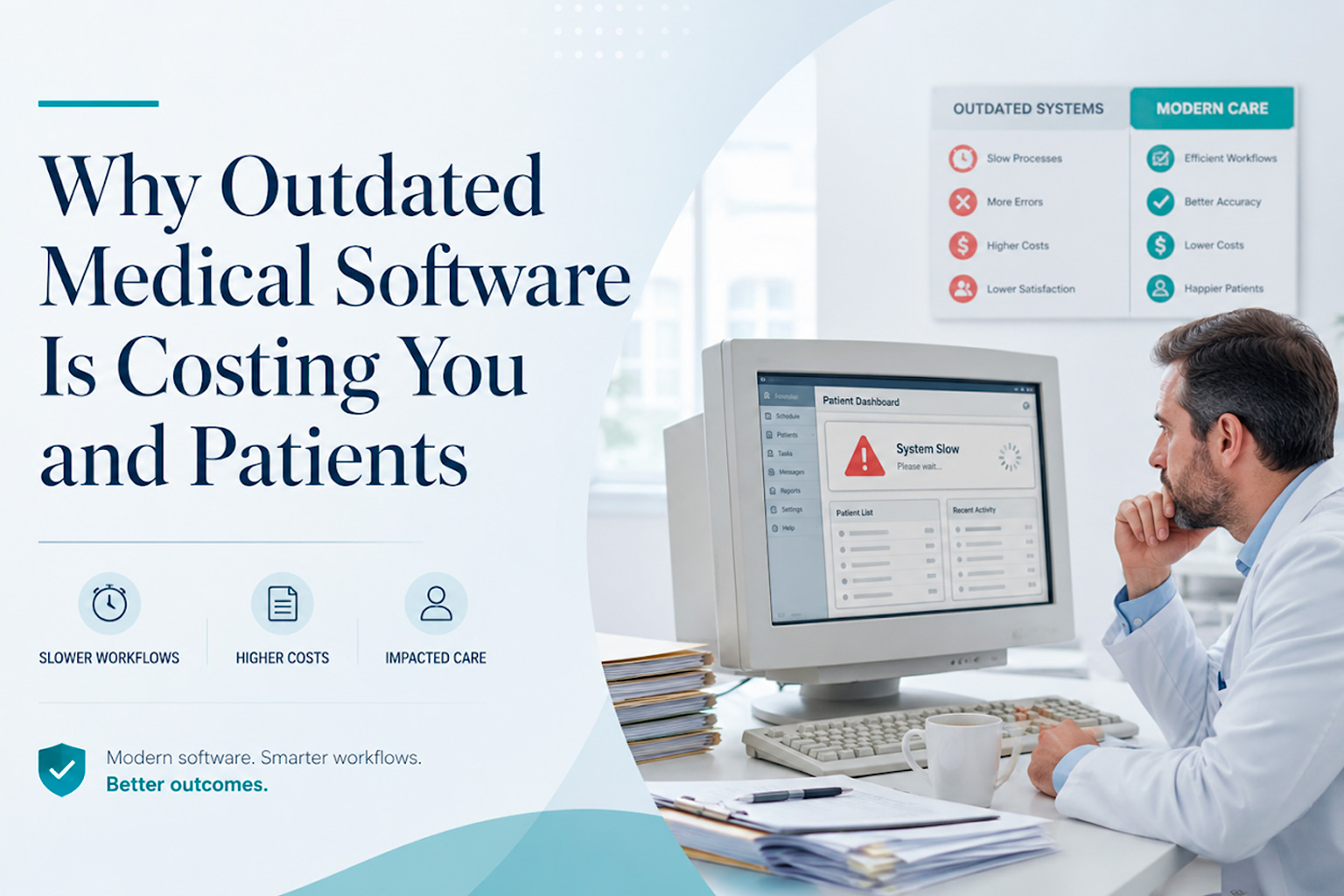
Why Outdated Medical Software Is Costing You and Patients
27 Aug 2026
Your patients are moving forward. New expectations, new comparisons, new tolerance for friction, all shaped by every fast, frictionless digital experience they have outside your walls. Your technology needs to move with them.
Too many hospitals and clinics are still asking staff to work around software that was never built for today's patient volumes, today's data demands, or today's expectations. And every workaround has a cost, one that shows up first in your operations, and eventually in your patient satisfaction scores.
The Problem: Your Software Is Still Loading
Patients need answers. Staff need speed. And in far too many care settings, the software sitting between them is still loading.
An outdated system can turn a two-minute task into a fifteen-minute one. A single delayed record pull can back up an entire clinic schedule. None of this is a staffing problem or a training problem; it's an infrastructure problem, and infrastructure problems compound.
Legacy medical software is more common than most healthcare leaders would like to admit. A large share of U.S. hospitals still run at least one mission-critical application on infrastructure that predates cloud computing, modern APIs, and FHIR-based data exchange- systems that were sound investments fifteen years ago and liabilities today.
The Hidden Cost of Outdated Medical Software
A slow system isn't just an inconvenience. It quietly drains the organization in ways that rarely show up on the same spreadsheet as the software's original price tag:
- Longer patient wait times: every extra click for a staff member is an extra minute in the waiting room for a patient.
- More manual work: data that should sync automatically gets re-entered by hand, one screen at a time.
- Higher operating costs: legacy maintenance contracts, specialized support staff, and workaround tools all add up.
- More room for human error: manual re-entry and disconnected systems are where transcription mistakes and missed updates happen.
And unlike most operational costs, this one is felt directly by the people you exist to serve. Patients feel every delay, even when they don't know the cause.
Signs Your Healthcare Software Is Already Holding You Back
It's not always obvious that software has become the bottleneck rather than the tool. A few reliable signs:
- Staff keep spare paper workarounds “just in case” the system is slow again.
- Different departments keep their own spreadsheets because the core system can't be trusted to have current data.
- New hires need weeks to learn interfaces that should take an afternoon.
- IT tickets for the same recurring issue never fully get resolved, only patched.
- Adding a new integration (a lab vendor, a billing partner, a telehealth tool) takes months instead of days.
If two or more of these sound familiar, the software isn't just old; it's actively shaping how care gets delivered.
The Bigger Problem: Disconnected Systems Behind Modern Equipment
Here's what makes this issue easy to miss: a hospital can have the newest diagnostic equipment, the newest imaging tools, and the newest devices at the bedside, and still be held back because the software connecting all of it can't communicate.
The average hospital runs a large number of separate systems, many of which were never designed to talk to one another. The result is fragmented patient data spread across platforms, with staff left to manually reconcile information that should already be unified. Poor interoperability across the healthcare system is estimated to add tens of billions of dollars a year in unnecessary administrative costs, money spent making systems cooperate instead of caring for patients.
Modern equipment without modern software isn't a modern hospital. It's a team where half the players can't hear the play call.
The Human Impact Behind the Screen
There's a gap between how a delay looks from IT's side and how it feels from the patient's side, and that gap is where trust erodes.
IT sees a system delay: a ticket, a timestamp, a known issue already in the queue. A patient sees something much simpler: why am I still waiting? They don't see the backend integration failure or the batch job that hasn't finished. They see a closed door, a quiet front desk, and a growing sense that something isn't working the way it should.
That difference matters more than most technology budgets account for. Patient experience scores, online reviews, and referral behavior are all downstream of moments exactly like this one.
What Modern Healthcare Software Should Actually Do
Healthcare software modernization isn't about chasing the newest interface. It's about removing the friction that outdated systems create at every step of the patient journey. The right software should:
- Connect: unify patient data across departments, vendors, and care settings instead of trapping it in silos.
- Automate: remove repetitive manual entry so staff time goes toward patients, not paperwork.
- Communicate: support real interoperability standards (HL7, FHIR) so new tools and partners integrate in days, not months.
- Scale: handle rising patient volume and data demands without a proportional rise in IT overhead.
Technology should remove friction from care, not add to it.
How to Modernize Without Disrupting Patient Care
The biggest objection to modernization is rarely “we don't need it”; it's “we can't afford the disruption.” A well-run modernization effort avoids that risk with a phased approach:
- Audit first. Map every system currently in use, where data gets stuck, and where staff has built manual workarounds.
- Prioritize interoperability. Fixing how systems exchange data usually delivers faster returns than replacing any single system outright.
- Roll out in phases. Modernize by department or workflow rather than attempting a single disruptive cutover.
- Train alongside deployment. Software adoption fails when training is treated as an afterthought rather than part of the rollout.
- Choose a technology partner with healthcare-specific experience. Compliance, security, and clinical workflow context aren't optional extras; they're the foundation of a safe rollout
Choosing the Right Healthcare Software Modernization Partner
Not every software vendor understands healthcare, and not every healthcare IT team has the bandwidth to modernize legacy systems while still keeping today's operations running. When evaluating a partner, look for:
- Proven experience with HIPAA-compliant architecture and healthcare data security.
- Real, hands-on expertise with HL7 and FHIR interoperability standards.
- A track record integrating EHRs, lab systems, billing platforms, and telehealth tools.
- Engineering teams that can scale with your organization rather than a one-time project handoff.
NanoByte Technologies works with healthcare organizations to modernize the systems behind patient care, from legacy platform upgrades to building the interoperability layer that lets existing tools finally work as a team. The goal isn't a bigger tech stack; it's a tech stack that stops getting in the way.
Frequently Asked Questions
What counts as outdated medical software?
Any clinical, administrative, or billing system that can't integrate with modern tools, lacks current security support, or requires significant manual workarounds to function day to day, regardless of how recently it was purchased.
How much does legacy healthcare software actually cost a hospital?
Beyond the visible maintenance and support contracts, the higher costs are indirect: staff time lost to manual work, slower patient throughput, higher error rates, and the security exposure of running unsupported systems.
How long does healthcare software modernization take?
It depends on scope, but a phased approach, starting with interoperability and highest-friction workflows, typically shows measurable improvement within the first few months, well before a full system replacement is complete.
Is EHR interoperability the same thing as software modernization?
Interoperability is usually the fastest and highest-impact piece of a modernization effort, but full modernization also covers automation, scalability, and security. Interoperability is the foundation, not the whole structure.
The Takeaway
Your patients are moving forward. Your technology should too.
Don't let outdated software become the bottleneck standing between your patients and the care your team is already capable of delivering. Modernize the systems behind the scenes, and let your staff and your technology finally work as one team.
Ready to see what modern healthcare software could look like for your organization? Talk to NanoByte Technologies about a healthcare software modernization assessment.


.jpg)